118
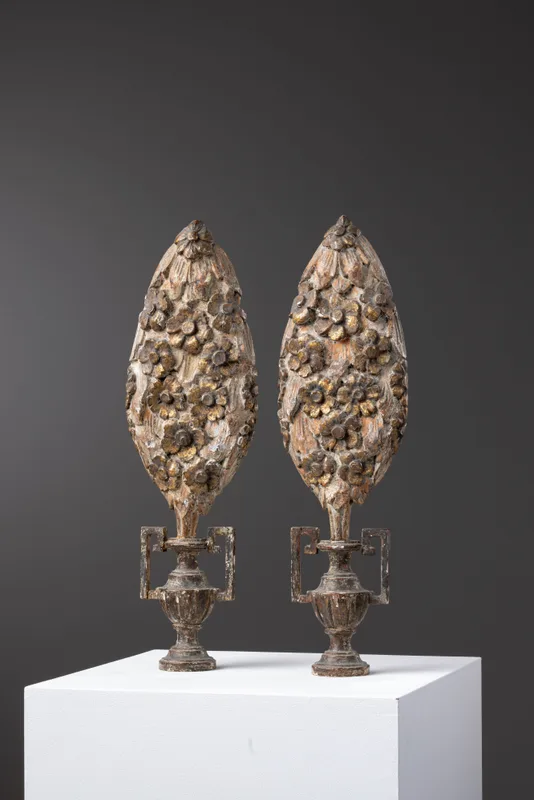
A pair of palmitos
Estimate €600–800

117
Estimate €20.000–40.000
Walnut, carved and parcel-gilt with oak and laurel branches and leaves.
Legs of inverted pyramidal form. Pierced and carved splat with a central oval medallion banded in pau-santo and inlaid with marquetry of pau-santo and hawthorn depicting the Portuguese royal arms.
Nailed seat upholstered in a chinese coverlet, 18th century.
Exhibition sign bearing the inscription ‘PORTUGUESE ART EXHIBITION LONDON – OCTOBER 1955 Casal. No. 443’.
Portugal, last quarter of the 18th century.
(seat fabric in poor condition; chair with signs of wear, minor losses and defects, traces of woodworm.)
89x56x50 cm
A chair between Portugal and London: a return to the land that inspired it.
The chair offered for auction by MATER is representative of the remarkable shift in taste that took place in Portuguese furniture design during the last quarter of the 18th century. During this period, under the reign of Queen Maria I, the sinuous, more fluid forms of the Rococo were succeeded by a growing preference for a return to classical linearity and the consequent geometrisation of forms.
The design of this chair reveals the assimilation of a cosmopolitan neoclassical taste, in dialogue with the finest trends circulating in other European courts and artistic centres. The structure’s elegant lines, the inverted pyramidal legs, the scalloped seat and the central oval medallion bring it into line with the international Neoclassical repertoire, more particularly the English style associated with George Hepplewhite (c. 1727–1786). The proportions of the frame, the shield-shaped backrest and the tapered legs are reminiscent of the models which, from the 1770s onwards, helped to profoundly transform European furniture. Hepplewhite’s design vocabulary, disseminated chiefly through The Cabinet-Maker and Upholsterer’s Guide, published posthumously in 1788, was characterised by a particular preference for backrests in oval, shield or heart shapes, lighter structures and neoclassical-inspired decoration, often based on plant motifs. The ornamentation is organically integrated into the structure of the piece, from the legs to the backrests, where the wood is worked into elaborate carved and openwork motifs. The lightness of the forms results from the balance between curves and straight lines, which come together in a harmonious dance. This style, closely aligned with the taste developed within Robert Adam’s circle, quickly spread beyond British borders and found an echo in the leading aristocratic households and European workshops. In Portugal, these designs were assimilated and reinterpreted, giving rise to pieces of great quality and character. It is precisely in this combination of an international design and Portuguese craftsmanship that a significant part of the interest in this chair lies.
Crafted from walnut, it features carved and gilded decoration of oak and laurel branches and leaves, motifs that take on particular significance within the piece’s symbolic context. Associated since antiquity with the concepts of strength, glory, victory and permanence, these plant elements gradually became part of the allegorical and honourific repertoire associated with the representation of sovereign power. Their presence, combined with the Portuguese royal coat of arms, thus appears to go beyond a merely ornamental function, contributing to the creation of a genuine programme of royal exaltation. This interpretation is particularly interesting because the evocation of the Crown is not confined solely to the central medallion. The royal arms, executed in marquetry, form the explicit core of the heraldic composition, whilst the oak and laurel branches are distributed throughout the chair’s structure, echoing—through the plant ornamentation—the same idea of power, glory and royal dignity. In this way, the decorative vocabulary and heraldry appear to work in tandem, transforming a design of clearly English origin into a piece with a strongly representative Portuguese character.
The chair’s historical significance is reinforced by its inclusion in the ‘Exhibition of Portuguese Art in London (800–1800)’, organised by Reynaldo dos Santos at the Royal Academy of Arts between October 1955 and March 1956. Displayed in Room VI, dedicated to the 18th century, the piece was catalogued under no. 443:
“One of the most evocative corners of the exhibition brought together in a harmonious ensemble various items, including one of the rare neoclassical tables bearing the mark of a Portuguese cabinetmaker (Raposo), a chest of drawers and a dressing table, all from the R. Espírito Santo, and various models of chairs from Queluz, or donated by Mr Henrique Chaves, Engineer, and Commander Ernesto de Vilhena, alongside Arraiolos rugs, Indo-Portuguese bedspreads and, above all, paintings. Rounding off the décor were various silverware, porcelain and glassware from Vista Alegre and a bust of Queen D. Maria I, by Rato, whilst a frieze of tiles decorated in the ‘Adam’ style served as a backdrop to this corner’.1
In this corner of the room, one could also see paintings such as the famous portrait of the Count of Farrobo and the allegory of the arrival of King João VI, both by Domingos Sequeira, as well as a portrait of Angelica Kauffman by the painter Vieira Portuense. The photograph of the room allows us to recognise the chair within the context of this important international exhibition, bearing witness to the esteem in which it was already held within the landscape of Portuguese artistic heritage.
At the time of the exhibition, as mentioned both in the accompanying text and in the 1950 book Leitos e Camilhas Portugueses, the chair was part of the collection of the engineer Henrique Chaves (1886–1976), a prominent figure in Portuguese collecting. He spent a significant part of his career in the railway sector. He was an engineer with the State Railways and, later, director of the Benguela Railways, a post he had already held by 1929. On his return to Portugal, he settled in Évora, where he went on to play an important role in the city’s public and cultural life. He served as Mayor of Évora from 16 December 1946 to 8 September 1952, a period characterised by a particular focus on the protection and promotion of Évora’s historical and artistic heritage. A collector and patron of the arts, Henrique da Fonseca Chaves maintained close ties with Évora’s cultural scene, supporting key figures in the study and preservation of the city’s heritage, including Túlio Espanca (1913–1993), author of studies on Évora’s artistic and architectural heritage. He was awarded the rank of Commander of the Order of Agricultural and Industrial Merit.
This remarkable chair, now being auctioned by MATER, has followed a unique journey between Portugal and England: designed in Portugal in the English style, it would return to London almost two centuries later as a testament to the originality with which Portuguese furniture was able to assimilate and reinterpret models from across the Channel.
NASCIMENTO, J. F. da Silva – Cadeiras Portuguesas/ Leitos e Camilhas Portugueses: subsídios para o seu estudo. Lisboa: Edição do Autor, 1950;
SANTOS, Reynaldo dos – Exposição de Arte Portuguesa em Londres (800-1800): Royal Academy of Arts, outubro 1955-março 1956. Lisboa: Imprensa Gráfica de Bertrand / Royal Academy of Arts, 1957.
Exposição de Arte Portuguesa em Londres (800-1800): Royal Academy of Arts, October 1955 - March 1956, nº 443.
The relationship between what we see and what we know is never complete. The way we see things is influenced by what we know, or by what we believe.