156
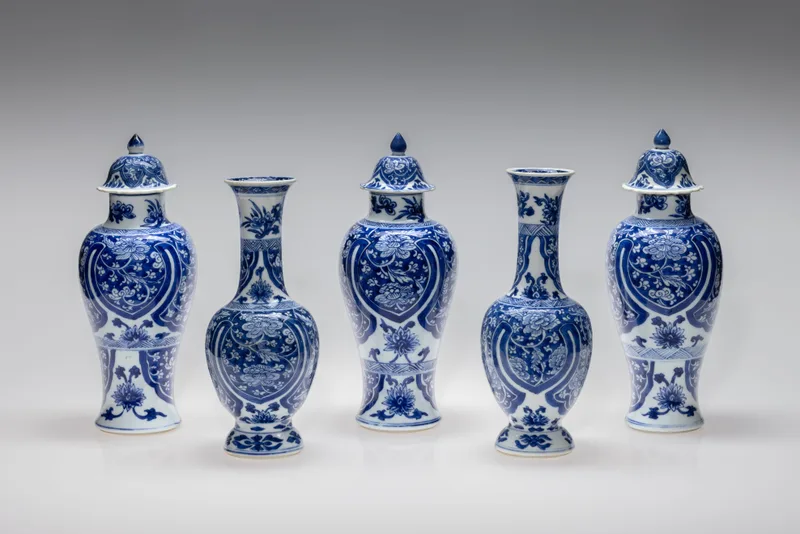
Five-piece Kangxi (1662–1722) garniture
Estimate €4.000–6.000

155
Estimate €20.000–40.000
Glass in shades of green, blue, brown, ocher yellow and black.
Multi-layered and acid-etched decoration depicting swans in a lakeside landscape.
Signed.
France, Nancy, Établissements Gallé, after 1904.
(minor wear to the base.)
14x14.8 cm
The bowl that survived the wars
In 1941, the Germans occupied Greece and took control of Athens, establishing their headquarters at the Negrepontis residence in Constitution Square, next to the Royal Palace. The house belonged to Miltiadis Negrepontis, a prominent Greek politician and economist, who, amongst other roles, served as Minister of Finance and President of the Hellenic Olympic Committee between 1918 and 1920.
Following the occupation, the family was forced to vacate the main rooms of the residence and move into the servants’ quarters, where they remained for around two years. Without hot water and with virtually no comforts, they endured the harsh Athenian winters during a period marked by a scarcity of resources. The poorest starved to death, whilst the more fortunate drew on their wealth to obtain food.
It was against this backdrop that the family sought to protect their possessions. The attic of the residence contained sand, used for thermal insulation, but it was there that jewellery and other valuables were hidden, including this bowl. Some items were eventually sold during the occupation, as circumstances demanded, but others managed to survive those years.
After the war, the bowl was inherited by Eleni Negreponti (1896–1971), a writer and literary critic known by the pseudonym Alkis Thrylos. The daughter of Miltiadis Negrepontis, Eleni was the second wife of the Greek poet, writer, journalist and diplomat Kostas Ouranis – the literary pseudonym of Kostas Niarchos – who served as Consul-General of Greece in Lisbon between 1920 and 1924.
By inheritance, the bowl then passed to Maria Angele Santiago Niarchos (1920–2014), the only daughter from Kostas Ouranis’s first marriage to Manuela da Cunha Santiago.
In 1998, Maria Angele decided to leave Greece and settle in Lisbon. It was then that some of the objects she had kept with her crossed the Mediterranean, bringing to Portugal memories of a family and a city deeply scarred by war.
More than just an object that has passed through generations, this bowl is a silent witness to one of the most difficult periods in Greece’s recent history. Hidden away during the Nazi occupation, it survived not only that, but also a civil war, the dispersal of the family’s possessions and, decades later, Maria Angele’s move to Lisbon. Its story is, therefore, also the story of a family that found ways to preserve it, even in times of adversity, when the passage of time and wars might otherwise have caused it to disappear.
-By succession to Maria Angel Santiago Niarchos (1920-?), the only daughter of his first marriage to Manuela da Cunha Santiago (1890-1954);
The relationship between what we see and what we know is never complete. The way we see things is influenced by what we know, or by what we believe.