295
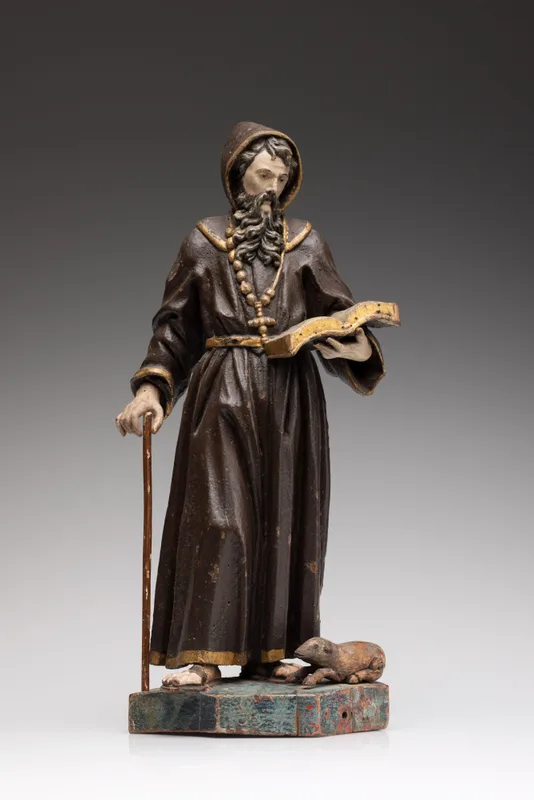
Saint Anthony the Abbot
Estimate €500–1.000

294
Saint John the Baptist
Estimate €15.000–30.000
Carved, polychromed and gilded wood sculpture.
Depicted standing, supported on a tree-trunk base, barefoot.
Presents a dynamic and sinuous posture, with the right arm raised and the hand resting upon a lamb which, in turn, rests upon an open book.
Gaze directed downwards, framed by wavy hair and an abundant beard.
Spain, 16th century.
(signs of wear, minor losses and defects)
H.: 54 cm
The present sculpture reveals close affinities with the production of Alonso Berruguete (c. 1488–1561), particularly with the male figure attributed to the sculptor and held at the Metropolitan Museum of Art, in New York, but also with a group of sculptures from the Retablo Mayor de San Benito el Real, in Valladolid, executed between 1526 and 1532, among which the Saint Sebastian, the Saint Christopher and the Sacrifice of Isaac are especially noteworthy.
Despite the iconographic and compositional differences, these works share a very particular sculptural language: figures of elongated proportions, unstable bodily axes, serpentine movement, expressively inclined heads and a deeply undercut treatment of hair and beards. The design of the draperies, constructed through broad, deep and sinuous folds, likewise establishes an evident formal proximity, as does the articulation between carved wood, polychromy and gilding.
Particularly significant is the concentrated expression of the physiognomies and the way in which Berruguete uses the inclination of the head and the movement of the gaze to confer upon the figures an intense emotional dimension. These elements are equally present in the Saint John the Baptist, whose retabular conception and sculptural treatment reinforce the approximation to the world of Berruguete.
The sum of these formal correspondences allows this attribution to be proposed, situating the work within the context of the renewal of Spanish polychrome wood sculpture in the first decades of the sixteenth century.
Collection Dr. António Miranda.
The relationship between what we see and what we know is never complete. The way we see things is influenced by what we know, or by what we believe.