305
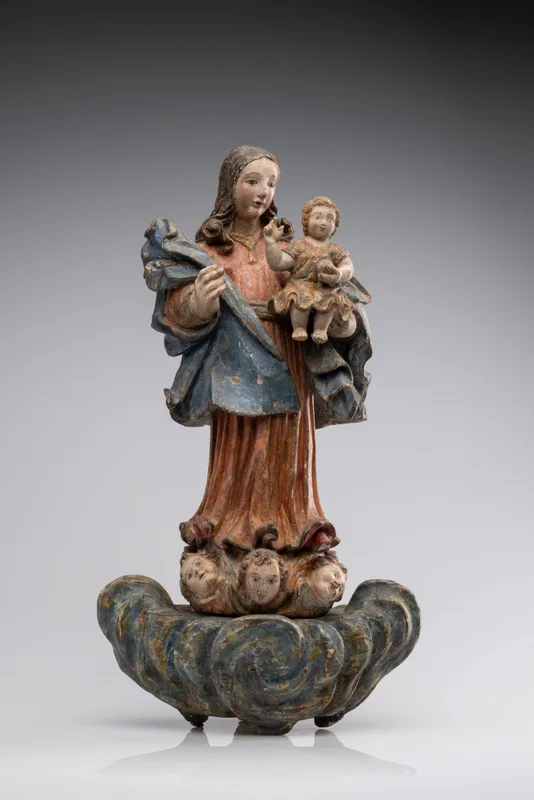
Our Lady of the Rosary with the Child
Estimate €500–1.000

304
Estimate €400–800
Full sculpture in the round, possibly representing Saint Joseph, with strong features, long wavy hair and a carefully modelled beard, wearing a blue tunic decorated with floral motifs, a gilded mantle and a cape edged with a gilded band. It presents a lace collar and cuffs, epaulettes on the shoulders and a cord around the neck, from which hangs a particularly elaborate ornament.
Portugal, 18th century (1st half).
(losses and defects)
H.: 30 cm
The identification of the figure as Saint Joseph finds particular support in the extraordinary closeness to the representation of the saint in an eighteenth-century engraving, whose composition and formal treatment appear to have constituted an important source for the execution of the present image. The correspondence is particularly evident in the physiognomy, in the treatment of the hair and beard, in the position of the figure, and in the general structure of the composition.
Equally significant are the similarities observable in the garments: the cape with epaulettes, the collar and lace cuffs, as well as the cord at the neck and the pendant, present solutions very close to those observed in the engraving. The construction of the face, with wavy hair framing it, the beard, and the serene expression, reinforces the relationship between both representations.
The present sculpture does not, however, constitute a literal reproduction of the engraved model. The sculptor introduced alterations, the most significant being the substitution of the position of the right hand — which in the engraving appears free — by the presentation of a closed book. This alteration may correspond to the adaptation of the model to a different iconographic reading of the figure, or simply to the intention of endowing the image with an attribute proper to the personage represented.
The presence of the book introduces, moreover, a relevant question regarding the iconographic identification. Although it is an attribute that may be found in the representation of Saint Joseph, its presence equally allows consideration of the hypothesis that this may be Saint Louis IX, King of France, whose iconography also encompasses representation with a book.
The extraordinary correspondence with the engraving remains, thus, the fundamental element for the reading of the piece. The image appears to result from the three-dimensional appropriation of an eighteenth-century graphic model, preserving its principal physiognomic, compositional, and decorative characteristics, whilst introducing alterations intended to adapt the figure to the language proper to devotional imagery.
The identification as Saint Joseph remains, in this way, the most probable hypothesis, although the presence of the book counsels keeping open the possibility that this may be another figure, namely Saint Louis of France. The piece constitutes, in either case, a particularly interesting example of the circulation and transformation of engraved models in Portuguese devotional sculpture of the first half of the eighteenth century.
Collection Dr. António Miranda.
The relationship between what we see and what we know is never complete. The way we see things is influenced by what we know, or by what we believe.