388
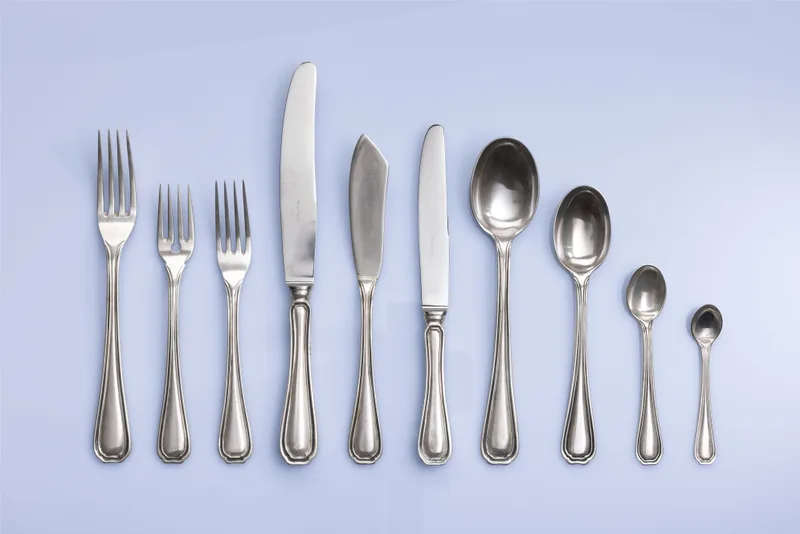
A cutlery set for six
Estimate €2.700–5.000

387
Estimate €1.500–2.500
Portuguese silver of approximately 900/000 standard. Raised and finely chased rocaille decoration. Bell-shaped top with scrolls, flowers, shellwork, spherical pendants and three cherubs. Fixed chains of neoclassical taste with oval links and floral bosses. Body with raised and chased decoration featuring cartouches, scrolls, flowers and leaves; detachable nozzle fitting with raised decoration of stylised leaves. Arms and lower finial finely chased with rocailles and flowers, and articulated pendants with leaves and pear-shaped fruits.
Portuguese, second half of the 18th century.
(signs of wear, losses, broken parts and other defects)
H.: 81 cm
1,310 g
A very Portuguese oratory lamp
The collection of pieces from the Casa das Brolhas is rounded off by a silver oratory lamp. Dating from the last quarter of the 18th century and in keeping with the house’s late Baroque style, this lamp bears witness to the refinement of its interiors.
Following an Italianate formal structure, popularised in Portugal following King João V’s commissions for the chapel at the Ribeira Palace and the Chapel of St John the Baptist, the lamp from the Casa das Brolhas displays remarkable decorative freedom in its fusion of the formal languages of the Baroque, Rocaille and Neoclassical styles. This assimilation of various aesthetic influences into a single piece is characteristic of Portuguese taste during the reign of Queen Maria I (1777–1816).
In the Brolhas lamp, the chiselling of the base, the arms and the upper bell-shaped shade was executed in the most exquisite rocaille style, creating cartouches, flowers, large volutes and fanciful scalloped motifs. For their part, the chains herald the rationality and return to classical restraint that characterised the Neoclassical style. However, the neck of the bowl, where the flame was held, is a pure exercise in classical Baroque, which could have been executed in the late seventeenth century. Indeed, it is this plasticity and creative freedom that make Portuguese artistic expression particularly interesting between the second half of the 18th century and the early 19th century.
The silver lamp from the Brolhas is a particularly eloquent testament to Portuguese goldsmithing of the late 18th century, with the great added value of knowing for which interior it was designed and where it was enjoyed.
Indeed, the exceptional quality of the works from this small yet significant collection, originating from the Casa das Brolhas and which MATER has the privilege of presenting, speaks louder than any theoretical essay on the importance of this house to the history of the Portuguese Baroque. In the heart of Lamego, it bears witness to a Europe united by aesthetics and by a cosmopolitan aristocracy – well-travelled and, in this case, elevated to the most important international posts.
Casa das Brolhas, Lamego
The relationship between what we see and what we know is never complete. The way we see things is influenced by what we know, or by what we believe.