620
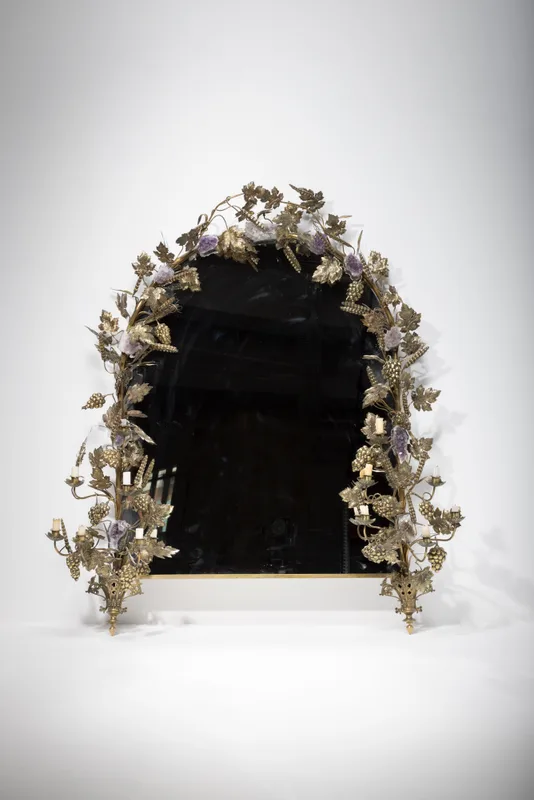
Wall mirror in the Art Nouveau taste
Estimate €1.500–3.000

619
An important wall mirror
Estimate €3.000–6.000
In wood with carved and gilded wood elements, with raised lead friezes in gilt.
Central mirror of rectangular format with mirrored frame.
Upper bevelled mirror with sinuous-profile mirrored frame decorated with foliate motifs.
Upper finial of cut profile, glass in red tones with stylised flowers, centred by an ornamental element with an oval medallion with the same decoration, surrounded by acanthus leaves.
Sweden, 18th century (first quarter).
(wear signs, losses, defects and minor restorations)
180x84 cm
A Swedish mirror at the Casa das Brolhas
Among the Brolhas’ collection, this important wall mirror stands out; it is an example of Swedish craftsmanship from the first quarter of the 18th century, attributed here to Burchard Precht (1651–1738).
A native of Bremen, Precht settled in Sweden whilst still young and went on to become a court sculptor. His collaboration with the architect Nicodemus Tessin the Younger, and the study trip they both undertook to France and Italy between 1687 and 1688, were instrumental in the development of an internationally influenced Baroque style, particularly evident in interior decoration and the production of mirrors.
This particular example brings together some of the most characteristic elements of this style: carved and gilded wood, sinuous mouldings, plant motifs and the use of coloured glass – here in shades of red – in a top border of great decorative effect. The combination of these materials and the richness of the composition lend it the theatrical character typical of ceremonial mirrors produced in Sweden during this period.
Its significance is reinforced by its provenance. An old photograph of the interior of the Casa das Brolhas documents this very mirror hanging in one of its rooms, confirming its presence in the house and, in a particularly rare instance, revealing the object’s relationship with the domestic space for which it was intended.
This provenance takes on particular interest when we consider the family’s international connections. Manuel Pinto da Fonseca (1681–1773), a native of Lamego and the 68th Grand Master of the Order of Malta, was deeply connected to the cosmopolitan world of Malta, where he commissioned the construction of the so-called Brito Palace in Valletta. Through successive inheritances, the property would later come into the possession of Macário de Castro Pereira Coutinho, Lord of the House of Brolhas.
The presence of this mirror in a stately home in Lamego thus stands as a particularly telling testament to the circulation of luxury objects and artistic styles across Europe during the 18th century, as well as to the cosmopolitan openness of Portuguese aristocratic interiors.
Casa das Brolhas, Lamego.
The relationship between what we see and what we know is never complete. The way we see things is influenced by what we know, or by what we believe.