71
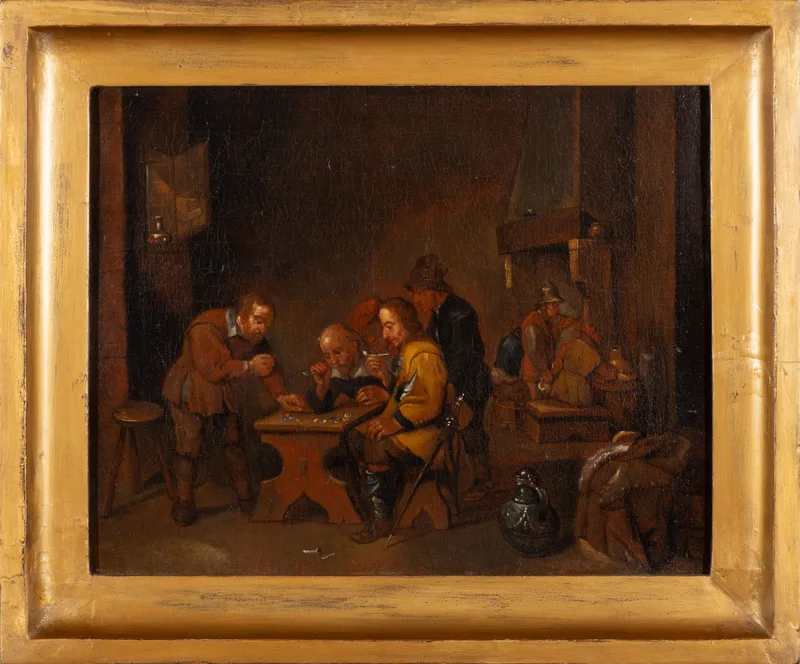
Interior of a tavern with players
Estimate €400–600

70
The Card Players
Estimate €10.000–15.000
Oil on canvas.
Signed and dated 1643.
(relined, restorations)
105x129.5 cm
WILLEM VAN ODEKERKEN
The Card Players
1643
This signed and dated work is by the Dutch painter Willem van Odekerken (Nijmegen, c.1610 – Delft, 1677), known for his genre paintings and still lifes. Active in the city of Nijmegen (Gelderland), he soon settled in Holland, with his work documented in The Hague (c. 1631) and in Delft (c. 1643). The date of the painting, 1643, marks a pivotal moment in the artist’s career, as it coincides with the year of his admission to the prestigious Guild of Saint Luke in Delft, whereby he officially became a master painter in the city, with the legal right to sell his works, take on pupils and practise his craft freely. From this year onwards, he based his artistic and commercial activities in Delft, a period considered the most productive and interesting of his career. The master’s development reflects a transition in both geography and artistic influences, shaping his identity as a painter. Odekerken’s work is distinguished by exceptional technical quality, the naturalism of his compositions and his technical skill in capturing textures and reflections, although the body of surviving works by his hand is very small – which lends the painting now up for auction at MATER particular interest.
Willem van Odekerken, also known as Odekercke or Odekercken, belongs to the group of Dutch painters who, in the 17th century, favoured realistic or naturalistic themes as independent pictorial subjects – no longer merely props, elements of symbolic content, or backdrops for other subjects. Thus, genre painting – particularly in Holland – flourished, establishing itself with complete authority as one of the most brilliant and wide-ranging artistic expressions of the seventeenth century, by drawing close to the lives of its viewers and patrons.
In the 17th century, Holland ceased to form part of the Netherlands – its independence had already been established in 1579 and, subsequently, in 1585, it became the dominant capital of the United Provinces (of the North), a federated state comprising Holland, Friesland, Groningen, Gelderland, Overijssel, Utrecht and Zeeland. Dutch wealth and power lay in the hands of an enterprising and active bourgeois society that believed in social and economic success through work and trade. Church patronage and religious themes – tackled by only a few painters, such as Rembrandt and Jan Lievens – declined, and a predominantly bourgeois clientele emerged, which saw painting as the finest artistic medium for affirming the new national identity. The aim was to depict and showcase all the aspects, settings and scenes that reflected their prosperous and comfortable lifestyle, as well as their love for the charms of everyday life and nature. This trend, which had already begun in the 16th century, did not conflict with the guidelines of the Protestant Church, thereby promoting the emergence and consolidation of a number of specialist masters who met the enormous demand for genre paintings.
Artists of the first rank such as Frans Hals, Rembrandt van Rijn and Jan Vermeer represent the pinnacle of 17th-century Dutch painting. Around them emerged and gravitated a considerable number of masters who also produced work of extraordinary quality within the vast range of genres and sub-genres practised. Key figures such as Bartholomeus van der Helst and Gerard Ter Borch in portraiture; Pieter de Hooch and Gabriël Metsu in domestic interiors; Emanuel de Witte, Hendrik Cornelisz van der Vliet and Pieter Saenredam, in church interiors; Jan Steen, Adriaen van Ostade and Pieter van Laer, in rural life; Jacob van Ruysdael and Meindert Hobbema, in natural landscapes; Jan van der Heyden, in urban landscapes; Willem Duyster, in military scenes; Simon de Vlieger, Jan van de Cappelle and Jan van Goyen, in seascapes; Willem Kalf, Jan Davidsz de Heem, Pieter Claesz and Willem Heda, in still lifes; Dirck Hals in ‘merry companies’, amongst many others.
It is often claimed that the introduction of the ‘merry company’ into Dutch genre painting is attributed to Willem Buytewech (c.1591–1624), from the second decade of the 17th century onwards, with his contemporary Dirck Hals being the finest exponent of the continuity of this prototype or subgenre. It consists of the depiction of groups of people, gathered in a relaxed manner in an indoor setting, enjoying themselves, usually seated whilst eating, drinking, playing music and, at times, engaged in moments of seduction or play, around a table. Of the table and board games of the period, such as backgammon, card games became one of the most sought-after pictorial subjects, owing to the potential coexistence of hedonistic and moralising elements in the scenes depicted: card games as both an earthly pleasure and a vice; as a moment of enjoyment and as a harbinger of financial ruin. Often, the tricks or cheating are even shown to the viewer explicitly, though not always with the intention of a moralising double meaning. There are precedents, with different approaches and purposes, such as those by Lucas van Leyden (The Card Players, c.1520, Thyssen-Bornemisza Museum) and Caravaggio (The Cheats, c.1596–97, Kimbell Art Museum), whose theatrical and innovative style inspired countless artists throughout Europe, from Georges de La Tour (The Cheat with the Ace of Clubs, c.1630–34) to the Utrecht Caravaggists. In the Netherlands, masters such as Dirck Hals and some younger artists, including Pieter Codde, Willem Duyster, Judith Leyster, Jan Miense Molenaer and Willem van Odekerken, produced interesting interpretations of the theme.
It is within this context that the painting now being presented to the public by MATER fits. Odekerken, drawing on the theme of card playing, combines the sub-genres of ‘merry company’ and still life, demonstrating great technical proficiency, particularly in the depiction of textile, metallic and glass surfaces. He structures the composition around a modest table, covered with a green tablecloth, with a small number of objects on it, carefully chosen and positioned, amongst which several elements stand out: on the one hand, the two players and an accompanying figure – two men, one of whom is absorbed in his cards, and a woman holding three Aces –; on the other, a luxurious wine decanter and a crumpled white tablecloth, which extends across the right-hand side of the composition, where the artist’s signature and the date of the work are recorded. The informality and dishevelled nature of the scene – evident in the relaxed posture of the figures, the woman’s knowing glance, the piled-up coins and the roughly sliced white bread – suggest a dramatised human interaction, highlighting the naturalism of the compositional approach, the prominence of the female presence in the action and the humanity of the figures.
The game depicted appears to be romestecq, a historic Dutch card game for two, four or six players, divided into two teams, each with one, two or three players. If this is the case, the woman, richly dressed and adorned with pearls, would be revealing her winning cards to the viewer: a triche (a set of three aces, in this case clubs/picks/fiori, spears/swords/picche and diamonds/coins/quadri). The absence of the Ace of hearts/cuori may be intentional. Sometimes, the presence of certain cards in the deck, as in the painting attributed to Johannes van Wijckersloot (The Card Game in the Cradle, 1643–1683, Rijksmuseum), contributes to the coded conveyance of an idea or a particular allegory.
Willem van Odekerken’s works are held in private collections around the world, as well as in renowned museums such as the Rijksmuseum in Amsterdam and the Museum of Fine Arts in Budapest. The unusual combination of documentary rarity, technical mastery and iconographic richness makes this a particularly significant painting within the context of Dutch Golden Age art.
Fernando Montesinos
Conservador do Palácio Nacional de Sintra (PSML)
BIBLIOGRAPHY
ALPERS, Svetlana (1999): A arte de descrever. A arte holandesa no século XVII, São Paulo, Edusp-Editora da Universidade de São Paulo.
BÉNÉZIT, Emmanuel (2006): Dictionary of artists, v.10, Paris, Éditions Gründ.
MONTIAS, John Michael (1982): Artist and artisans in Delft. A socio-economic study of the seventeenth century, Princeton, Princeton University Pers.
SLIVE, Seymour (1998): Dutch painting 1600-1800, Yale, Yale University Press.
VAN DER WILLIGEN, Adriaan and MEIJIER, Fred (2003): A Dictionary of Dutch and Flemish Still-Life Painters Working in Oils 1525–1725, Leiden, Primavera Press.
The relationship between what we see and what we know is never complete. The way we see things is influenced by what we know, or by what we believe.