76
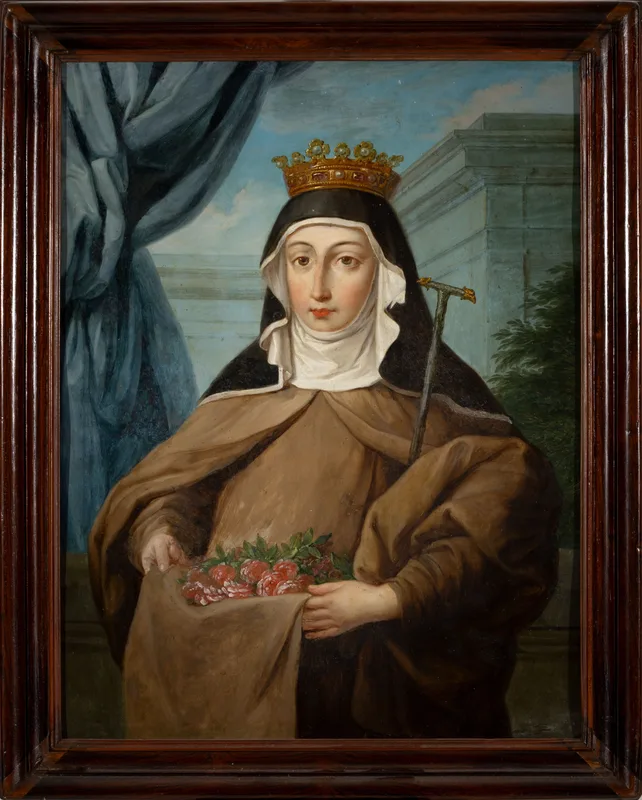
Queen Saint Elizabeth of Portugal
Estimate €1.500–3.000

75
The Kiss of Judas
Estimate €17.000–30.000
Oil on panel.
(minor restorations).
137x117 cm
The Kiss of Judas
This highly interesting Portuguese Mannerist work, dating from around 1600 and originating from an ancient, dismembered altarpiece of unknown provenance, constitutes a valuable testament to the period of extensive serial production conventionally known as the ‘Contra-Maniera’ (Counter-Reformation Mannerism) and of the art of the man who, at the turn of the 16th to the 17th century, was its most illustrious representative. It depicts the Arrest of Jesus in the scene of the Kiss of Judas, including the dynamic sub-theme of Saint Peter cutting off Malchus’s ear, which occupies the foreground of the composition.
Simão Rodrigues, its creator, was already considered in 1589 to be ‘one of the finest painters of oil-on-canvas religious imagery in these Kingdoms’; he also worked in fresco and as an illuminator, and was praised in 1696 by the discerning art historian Félix da Costa Meesen as a ‘man of rare ingenuity, and very skilful in painting’, a view confirmed by the fine quality of the drawing in this ‘Kiss of Judas’, inspired by models from Rome dating from the time of Gregory XIII and Sixtus V, under whom the painter trained. The subject, which Simão repeated on one of the panels in the sacristy of the Old Cathedral of Coimbra (c. 1607), now in the Machado de Castro National Museum, as well as on two workshop panels—one on the altarpiece of the Misericórdia de Tancos (c. 1600), on display at the Diocesan Museum of Santarém, and another in the church of Santa Maria do Castelo in Torres Vedras, is treated with compositional elegance and didactic intent, with careful attention to details of chiaroscuro that the nocturnal atmosphere accentuates. Simão certainly saw the frescoes in the Oratorio del Gonfalone in Rome, where he may have found an inspirational model for this precise composition. His art, in fact, follows the same models of the ‘pittura senza tempo’ associated with the Council of Trent, particularly those of the Roman painters of the generation of Federico Zuccaro, Cesare Nebbia and Livio Agresti – not forgetting Pomarâncio – and the influence of the Portuguese artist Campelo, from whom he drew inspiration in more than one work. It is this very late-Mannerist style, which dominated the pictorial canons of the Counter-Reformation during the Jubilee years around 1600, that is evident in this painting, so attentive to the clarity of its devotional discourse.
As was first highlighted by Adriano de Gusmão in the book Simão Rodrigues and his collaborators (1956), the painter’s most distinctive works demonstrate a quality that surpasses that of his contemporaries, as can be seen in the works in Coimbra (the sacristy of the Carmo Church and the University chapel). He ran a very busy workshop in the parish of Socorro, in Lisbon, where several artists worked, including the future royal painter Domingos Vieira Serrão (c. 1565–1632),
and several others whose names and works are known; this led to many of the commissions produced in this context suffering from formulaic repetition and revealing weaknesses in their finish. This is not the case with this splendid painting of The Kiss of Judas, which came directly from the master’s own hand. It is a work very typical of his direct repertoire, with the robustness of the figures’ poses (the stance of the soldiers, for example, is repeated in panel paintings such as those from the former altarpiece of Santa Cruz de Coimbra, now in the sacristy of the Carmo church in that city, dating from 1611), as well as the strong sense of pathos accentuated by the chiaroscuro modelling. Finally, the artist’s mastery of drawing is evident in his highly personal way of rendering the foreshortened heads, which serve as his signature.
Vítor Serrão,
Historiador de Arte, professor catedrático da Universidade de Lisboa
The relationship between what we see and what we know is never complete. The way we see things is influenced by what we know, or by what we believe.