79
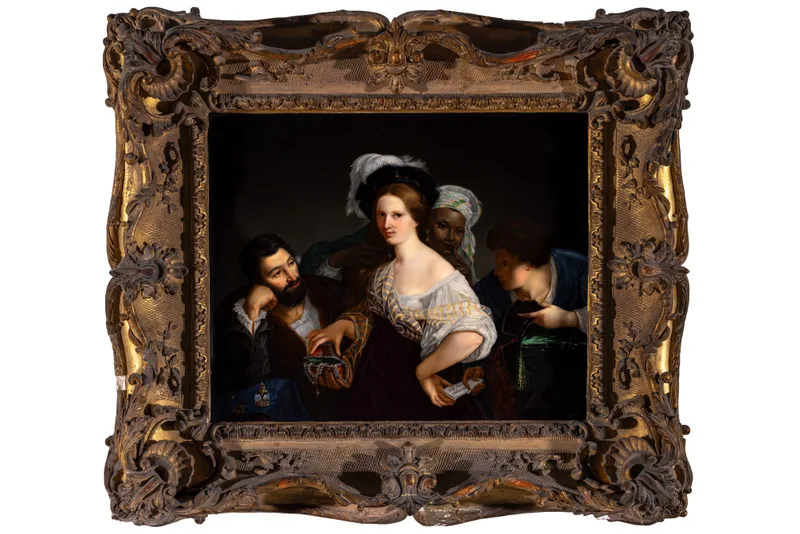
Madame Breton (1809-1895)
"La Jeune Courtisane"
Estimate €600–900

78
Estimate €1.200–2.000
Pair of oils on canvas.
English school, 19th century.
(minor restorations)
38x30.5 cm
The Peters:
From Prussia to Lisbon, portraits of the founders of a dynasty.
The pair of portraits presented here – in oil on canvas, unsigned and undated – belong to a codified style of European portraiture from the last quarter of the 18th century: half-length, three-quarter view, set within a faux oval frame on a rectangular panel, set against a landscape background. Clearly conceived as pendants, the two paintings engage in a dialogue through the poses of the subjects, the scale and the composition of the background, adhering to the conventions of contemporary bourgeois and diplomatic portraiture¹, within the sphere of Germanic models: one need only consider the gallery of merchants and scholars portrayed by Anton Graff (1736–1813) and the portraits by Jens Juel (1745–1802), in whose output the oval format (here simulated) became widespread from 1770 onwards². What sets apart, however, the pair of portraits now offered for sale at MATER is not only the quality and effectiveness of the compositional formula, but the possibility (rare in portraits that come onto the market) of restoring to the faces an identity, a biography and a concrete place in the economic and social history of post-Pombaline Lisbon.
This restoration begins, first and foremost, with the objects themselves, the primary and ultimate source of any study in art history. Both paintings retain handwritten inscriptions on the frame which presumably identify the subjects: ‘Great-great-grandfather / Christiano Daniel von Peters (Baron von Peters)’ and ‘Great-great-grandmother / Francisca Peters (Baroness von Peters)’. Another clue: a family tree, also handwritten, on the frame of the male portrait, when considered in relation to the degree of kinship (great-great-grandfather and great-great-grandmother) stated in those inscriptions.
The last name mentioned in the family tree – which we assume to be that of its author – is Maria Leonor Munró dos Anjos Diniz (1872–1940), daughter of Alice Joyce Munró (1850–1934) and Policarpo Pecquet Ferreira dos Anjos (1845–1905), a founding shareholder of Banco Lisboa & Açores (1875), a Peer of the Realm (1890) and a major industrialist.³ Now, if the figures depicted are her great-great-grandparents, they can only be, on her mother’s side, Christian Daniel Peters (1744–1821) and Anna Pelican, who were married in Lisbon in 1778⁴. The inscriptions, moreover, contain two errors that reveal the workings of family memory: the title of Baron of Peters belonged not to the man depicted, but to his father, Christian von Peters, a Palatine official at the Hungarian Court of the Habsburgs⁵, a native of Wismar (Mecklenburg), a Hanseatic city on the Baltic coast, which had been under Swedish political control since the end of the Thirty Years’ War (1648). In recording the identity of the ancestors in writing more than a century later, family tradition transferred the father’s noble title to his son – who shared his father’s name – in a common onomastic slip of the pen found in this sort of belated inscription. As for the name ‘Francisca’ attributed to the woman portrayed, this does not correspond to a Portuguese adaptation of the name Anna Pelican, but rather to a misunderstanding arising from the name of the couple’s daughter, Frances.
Even stripped of the title that posterity has bestowed upon him, the subject loses nothing of his historical stature. A native of Lübeck, Christian Daniel Peters was a prosperous merchant of Hanseatic origin and Consul-General of the Kingdom of Prussia in Lisbon, where he established his commercial activities between the late 18th and early 19th centuries. Following the death of his business partner, Johann Thomas Stattmiller, in 1787, Peters took charge of Prussian consular relations in Portugal, a post he held during a historically turbulent period⁶. It should be borne in mind that the legation in Portugal was one of Prussia’s second-tier representations in Europe⁷: in the absence of significant political relations between the two kingdoms, the legation’s activities focused primarily on economic and commercial matters. Nevertheless, the consulate in Lisbon (established in 1711) was the first to be set up by the Kingdom of Prussia on the European mainland⁸. The position of consul made Peters a prominent figure within the influential community of foreign merchants based in Lisbon’s financial centre; his reports on the activities of Prussian trading houses and commercial traffic at the port of Lisbon are recorded in the Prussian State Secret Archives⁹. Commercial and consular affairs are, in fact, inseparable; and this is no coincidence: unlike the rest of the diplomatic staff, Prussian consuls were recruited from among merchants and traders who had long been established in their host ports, and who applied for the post largely to avoid the taxes, duties and levies that burdened foreign merchants.¹⁰ Peters is a prime example. In the 1780s and 1790s, he acted as an agent for major bankers and merchants from Amsterdam – such as Benjamin Cohen (1726–1800) – and was directly involved in the purchase of diamonds from the Royal Diamond Mining Company, administered by the Portuguese Crown¹¹. The core of his business, however, lay in international shipping: taking advantage of Lisbon’s geostrategic position as a major transhipment hub between the Atlantic and the trade routes of northern Europe, Peters imported raw materials (on which Portugal was critically dependent to sustain its naval effort in the Atlantic) and manufactured goods (textiles, glassware, ironmongery), re-exporting them to northern markets through his network in Amsterdam, Hamburg and Lübeck.
Between 1801 and 1803, a period during which he was entrusted with the chancellery archives left by Baron von Schladen, extraordinary envoy and minister plenipotentiary, Christian Peters was elevated to the position of Chargé d’Affaires, becoming Prussia’s highest-ranking diplomatic representative in Portugal12. In this capacity, Peters witnessed, in Lisbon, the transfer of the Portuguese court and royal family to Rio de Janeiro and the entry of the French army, commanded by Junot (1771–1813). He was one of the few diplomats from nations hostile to France to remain in post in the capital, a status which, combined with the influence he wielded within the German community, proved crucial in protecting the commercial goods, warehouses and homes of Protestant merchants from requisitioning by the invading army.¹³ The Prussian diplomatic mission was only closed (and relocated to Rio de Janeiro¹⁴) with the dissolution of the Regency Council and the formal establishment of the French protectorate on 1 February 1808. From this period, Peters’ reports on the French occupation of Lisbon and the British naval blockade imposed at the mouth of the Tagus, under the command of Admiral Sidney Smith (1764–1840)¹⁵, are still preserved in Berlin. It is known that Peters died in 1821 and that his funeral attracted a large procession of foreigners and Portuguese ‘accompanying the body of this noble and esteemed man to his final resting place’ at the English Cemetery in Estrela, which served Lisbon’s Protestant community before the German Lutheran congregation had its own cemetery.¹⁶
As for the female half of the couple, Anna Pelican’s biography is brief (like that of so many of her female contemporaries, who passed through history anonymously), though it suffices as evidence of the family’s cosmopolitanism: her father, Robert Pelican (c. 1715–1788), was a native of Ireland, and her mother, Angela Fortunata Falchi, was a native of Cremona, in Lombardy. Anna and Christian Peters were married in Lisbon, suggesting that Anna, despite being the daughter of foreigners, may have been born on Portuguese soil.¹⁷ This marriage, in 1778, illustrates the cultural intermingling and the practice of forming family alliances amongst the foreign merchant bourgeoisie in eighteenth-century Lisbon. Six children were born of this union: Mary (b. 1777), Anna (b. 1779) and Johann (b. 1781) – whom we assume to have died in infancy – as well as Elizabeth (b. 1783), Christian Daniel (b. 1783) and Frances (b. 1789), who survived childhood. Two of them went on to make significant marriages: in 1810, Christian Daniel married Maria Isabel Scholtz (b. 1787), the daughter of a wealthy merchant (also of Hanseatic origin) and vice-consul of Denmark, who had long been established on the island of São Miguel¹⁸; and, in 1817, Frances married Domingos Grove Joyce (b. 1786), a businessman involved in transatlantic trade, who operated in Lisbon as part of the influential British Trading Post¹⁹, and who was subsequently politically persecuted during the Civil War (1832–1834) as a supporter of the liberal cause²⁰. From the marriage between Domingos and Frances Peters, a single daughter was born in 1821: Maria José Peters Joyce, who married Charles Alexander Munró (1819–1900) in 1844²¹. They were the parents, amongst other daughters, of Francisca Joyce Munró (1846–1926), who would go down in the history of Portuguese art as Fanny Munró. A naturalist painter and pupil of Silva Porto (1850–1893), she made her debut in 1887 at the 14th Exhibition of the Society for the Promotion of Fine Arts, with landscapes and still lifes, moving in the circles of Josefa Greno (1850–1902), José Malhoa (1855–1933) and Columbano (1857–1929), who painted her portrait in 1898²². The subjects of these portraits are, therefore, the artist’s great-great-grandparents.
Let us return to the canvases. Although none of the portraits is signed or dated, the clothing and hairstyles suggest they were painted (on commission?) in the last quarter of the 18th century. In Peters’s portrait, the powdered hair with side plumes, the jabot, the lace cuffs and, above all, the coat with a high collar – a style that became widespread from around 1770–1790²³ – place the portrait within this chronological period, which is, incidentally, consistent with the subjects’ marriage date (1778). In the portrait of Anna Pelican, both the dress and the hairstyle conform to the same chronology.
Note, too, the iconography. Unlike the portrait of the woman, which displays no attributes, the object held by Peters is a small bound book, a choice made by the artist or the patron which seems to us particularly effective in constructing the effigy of a high-profile merchant, signalling service and dedication to business, without the aristocratic pretensions that a column (usually in the background), a sword or an insignia might convey. In the context of portraiture under the Ancien Régime, it is worth recalling that the iconographic attribute is rarely a neutral detail: it is this that transforms the individual effigy into a social statement, declaring to the observer not only who the subject is, but also what he does and how he wishes to be remembered.²⁴ The portrait of Christian Daniel Peters is, therefore, the figurative declaration of a man who owes his position to merit, hard work and the social network into which he integrated – not to bloodline – and who wished to be seen in this light.
It is this dual nature (document and image) that lends this pair of portraits their greatest significance. Within them intersect the great trade routes of the Atlantic and the Baltic, the diplomacy of a European kingdom – Prussia – in Lisbon during the Napoleonic invasions, and a genealogy that, surprisingly, leads to a painter of the Portuguese Naturalist movement. As they move from the domestic sphere (where they were kept and annotated) into the public eye, Christian Daniel Peters and Anna Pelican begin a new chapter in their material biography, now as expressive testimonies to the cosmopolitanism of the communities of foreign merchants residing in post-Pombaline Lisbon.
Sérgio Monteiro Abrantes
Conservador de escultura do Palácio Nacional da Ajuda
The relationship between what we see and what we know is never complete. The way we see things is influenced by what we know, or by what we believe.