81
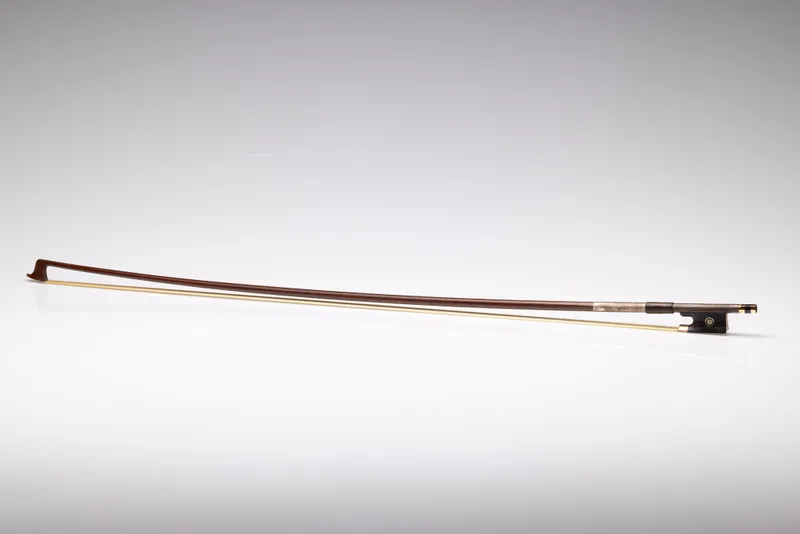
Violin Bow, W. E. HILL & SONS
Estimate €3.000–5.000

80
Estimate €70.000–100.000
Naples, circa 1750
labelled Nicolaus Gagliano Filius Alexandri fecit Neap. 17??
With case and some belongings
Length of back: 351mm, 13 5/16in
Documents
The dendrochronological report from Peter Ratcliff dated July 2026, stating the latest ring of the wood from
1749
The Rediscovery of an Exceptional Gagliano.
Kai Dase – Luthier
The Gagliano family was the most important and prolific violin making family in Naples and was active for two centuries. Remarkably, its earliest known member, Alessandro (1665-1732), is also the first known Neapolitan violin maker.
The works of his sons, Nicola (c.1710-1785) and Gennaro (1705-c.1790), are the most sought after among all the makers in this dynasty. While their father, Alessandro, developed his own model, Nicola and Gennaro used Amati and Stradivari models, as exemplified by the exceptional violin now offered for sale by MATER Fine Art. The overall output of the Gaglianos is immense and it is a delight to encounter such a pure example like the one we are looking at today.
When I was initially approached to make a valuation for this violin, I was duly intrigued but kept my mind open as to what to expect. Too often in this field, the labels that we find inside the instruments are not original and were inserted to deceive. However, when I opened the case and first glimpsed the instrument inside, its quality spoke for itself.
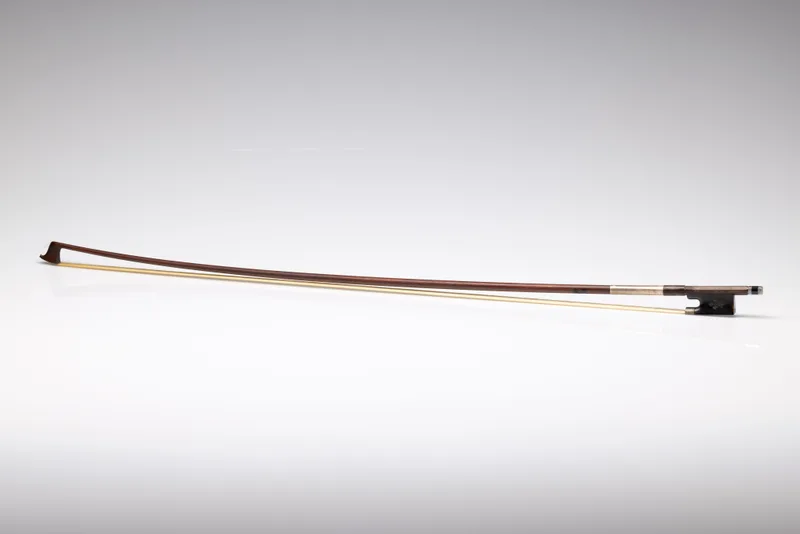
I would not normally look through the ffs so early on to seek out the label, but there was something about the outline, something about the ground and the varnish, and especially something about the purfling, that just boded really well. The gold mounted French bow that I saw from the corner of my eye peaked my enthusiasm further and the fleur-de-lys decor on the second bow was unmistakably from the Hill workshop.
Reading an instrument like this is always fun and exciting. Starting with the condition it is obvious that it had undergone some sympathetic and high-quality restoration in its past. As we are in Europe, my eye immediately looks for an ebony crown over the button and a Hill number, but even from the graft itself it was clear, that this work hadn’t been done at Hills.
The button replacement however has been beautifully matched and retouched, only the joint itself gives away that this work was done probably up to a hundred years ago. As the strings were partly broken and missing, I presumed that it hasn’t been played for at least around 40 or 50 years. An old bridge, stamped «Vidoudez», was stored in the small compartment, and curiously also a small cloth with the distinctive «CC» for Cartier.
The family confirmed that the first owner regularly travelled to Switzerland, where this fine set was purchased. Sadly, no accompanying paperwork has to this time been found. It is not a far stretch, however, to presume that this violin was bought together with the Fétique and Hill bows from the Vidoudez shop in Geneva, probably in the first half on the 20th Century.
The two halves of the front are made from excellent spruce with quite fine grain in the centre widening towards the flanks. The arching is strong and robust and shows no significant sinkage.
The expertly cut ff holes are upright and slender and are placed slightly further apart (almost 44m) and show only shallow fluting.
The back is of two pieces of very handsome maple with medium flames cut ever so slightly off the conventional radial cut, which creates a very pleasant cloudy and mottling effect in the figure. A small inclusion, most likely a sap pocket is visible on the treble side of the back, but upon deeper inspection there is no disturbance in the surface of varnish and other than reinforcing studs of the centre joint it has never been subject to repair. Inspection with UV light shows wear in this region but no added retouching varnish.
There is a slight discrepancy between the grain of the two halves of the back, but they are clearly the same tree, and as the wood for the ribs match the back extremely well, I surmise that the ribs were cut from the back wood.
The scroll is cut on the quarter and shows the fine medullary rays beautifully. The grain is similar to the back wood but has almost no flame.
The purfling is typical for this maker and in the c bouts of the back we can see some of the opacity that so often forms between his varnish and the purfling.
The varnish is a dark amber colour and is intact throughout the instrument showing no significant retouched areas. The dendrochronological report reads as follows:
“The most significant cross-matches place the latest measured ring on the bass side at A.D. 1740 and on the treble side at A.D. 1748. As spring growth of the following year is visible, the latest overall date for the wood is A.D. 1749. (…) The cross-matching tests have identified an exceptional number of highly significant correlations with instruments exclusively of Italian origin. The wood on both sides can therefore be described as being typical of the batches of spruce used throughout Italy during much of the eighteenth century. (…) Essentially, with a latest date of the wood of 1749, the belly of this violin could have been made from about the mid-1750s onward.”
Even with some repairs, the violin now offered of auction by MATER Fine Art is in beautiful condition and is a pure example of this highly desirable maker that has come to light after such a long time.
REPORT
Peter Ratcliff – Luthier
Dendrochronological Assessment of the Belly of a violin, Violin "Nicola Gagliano"
(from digital images)
Ref: kd2876
Description of Sample
The belly is made in two sections, jointed along the centre.
The grain orientation runs from edges towards the centre joint on both halves.
A total of 135 rings were measured on the bass side and 140 rings on the treble side.
Methodology
The ring-data were statistically tested using the cross-dating formula proposed by Baillie & Pilcher (1973) for their CROS algorithm which derives the Student’s t-value (TVBP) from the Pearson correlation coefficient r.
Dating Results
The most significant cross-matches place the latest measured ring on the bass side at A.D. 1740 and on the treble side at A.D. 1748.
As spring growth of the following year is visible, the latest overall date for the wood is A.D. 1749.
A comparison of the plotted data clearly shows very similar ring-patterns. Their inter-correlation reaches a highly significant t-value of 12, strongly suggesting that the two halves originate from the same tree.
As the two sides are related, their data were combined into a mean chronology, which generally provides a more representative growth pattern of the original tree than either individual series.
Regional Comparisons
The data were initially tested against published regional data from the International Tree-Ring Data Bank (ITRDB).
The strongest was identified with a composite central Alpine reference, reaching a highly significant t-value of T=7.23
The regional comparisons suggest a broad central Alpine origin for the tree, although the statistical evidence does not permit a more precise location to be proposed.
Instrument Cross-Matches
The most significant cross-matches with the mean chronology, listed in decreasing order of TVBP, are:
A violin by Jose Contreras,
A 1742 violin by Pietro Guarneri of Venice,
A c.1744 violin by Giuseppe Guarneri "del Gesù" "Padarewski",
A 1733 violin by Antonio Stradivari,
A c.1732 violin by Giuseppe Guarneri "del Gesù",
A 1725 violin by Giuseppe Guarneri "del Gesù" "ex-Field",
A 1744 violin by Giuseppe Guarneri "del Gesù" "Ole Bull",
A c.1740 violin by Camillo Camilli,
A 1734 violin by Antonio Stradivari "Habeneck",
A violin by Giovanni Battista Guadagnini,
A violin by Carlo Tononi,
A c.1742 violin by Giuseppe Guarneri "del Gesù" "Urso",
A 1742 violin by Giuseppe Guarneri "del Gesù" "Wieniavski",
A c.1728/30 violin by Giuseppe Guarneri "del Gesù" "Moller",
A 1739 violin by Camillo Camilli,
A 1711 violin by Antonio Stradivari,
A 1739 violin by Giuseppe Guarneri "del Gesù" "Menuhin",
A violin by Sanctus Serafin,
A violin by Giovanni Battista Ceruti,
A 1727 violin by Andrea Gisalberti,
A 1709 violin by Antonio Stradivari "Artot",
A c.1760 cello by Domenico Busan,
A late 1720 violin by Giuseppe Guarneri "del Gesù" "Warren Green",
A composite violin by Antonio Stradivari table probably Carlo Bergonzi,
A violin by Pietro Antonio Dalla Costa,
A violin by Michele Deconet,
A violin by the Bergonzi family,
A violin by Matteo Goffriller,
A c.1740 violin by Giuseppe Guarneri "del Gesù" "Kagan",
A violin by Carlo Bergonzi,
A 1710 violin by Antonio Stradivari,
and
A 1740 violin by Michael Platner (Rome).
Interpretation
The cross-matching tests have identified an exceptional number of highly significant correlations with instruments exclusively of Italian origin. The wood on both sides can therefore be described as being typical of the batches of spruce used throughout Italy during much of the eighteenth century.
Chronology and Making Date
Essentially, with a latest date of the wood of 1749, the belly of this violin could have been made from about the mid-1750s onward.
Peter Ratcliff Dendrochronology Ltd
Member of EILA, Entente Internationale des Luthiers et Archetiers
The present owner's grandmother, a Portuguese amateur musician, acquired the violin probably from Vidoudez in Geneva in the first half of the 20th Century. No paperwork of the purchase of neither the violin nor the two bows survives.
The relationship between what we see and what we know is never complete. The way we see things is influenced by what we know, or by what we believe.