778
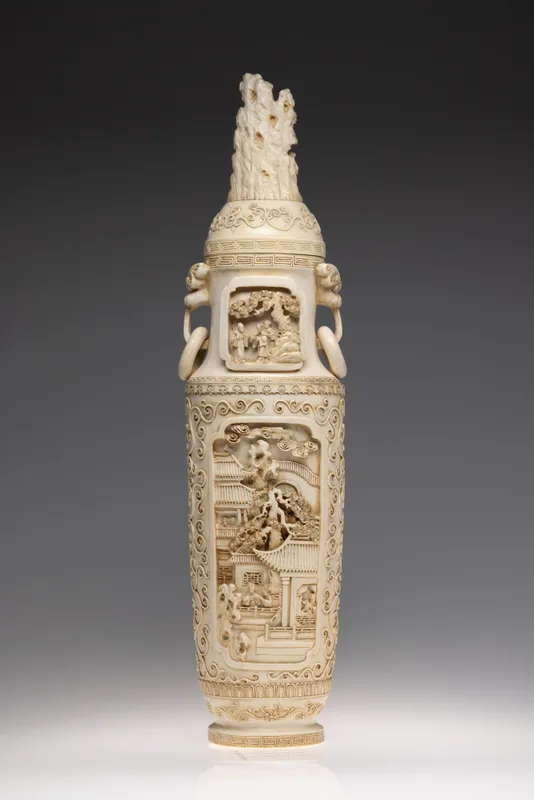
Chinese ivory piece with cover
Estimate €2.500–4.500

777
Estimate €1.500–3.000
Sculpture in terracotta.
Base in brecciated marble in white and bordeaux tones.
France, 19th century.
(minor losses to the patina)
H.: 72 cm
Madame Chauvire (?)
A terracotta bust in the style of Jean-Baptiste Pigalle and eighteenth-century revivalism
Among the works that MATER is offering for sale at its inaugural auction is a female bust, in patinated terracotta, set upon a turned plinth of brecciated marble. The young woman depicted turns her head slightly to the right; on her face, the introspective gaze and reserved smile convey the figure’s demure expressiveness, which the sculptor contrasts with the restrained sensuality of a suggestively bare bosom. Her hairstyle, piled high and encircled by a star-adorned diadem, flows into wavy locks that cascade in voluminous strands over the nape of her neck and her right shoulder; the bodice with its gathered pleats and the cloak draped à l’antique – a device that sets the subject apart from the fashion of the time – complete a figure whose attire embodies conventions common in eighteenth-century French sculptural portraiture,1 as seen in busts by masters such as Lemoyne, Pajou, Caffieri or Houdon. The reverse, treated only superficially and marked by spatula strokes, reveals a work intended for frontal viewing within a domestic setting. In its materiality, this bust encapsulates the imagery of the French court portrait of the second half of the eighteenth century and, simultaneously (as will be seen), the obsession with which the elites revived it in the following century.
It is, in all likelihood, a nineteenth-century copy of a terracotta bust attributed to Jean-Baptiste Pigalle (Paris, 1714–1785), now in the collection of the Michele and Donald D’Amour Museum of Fine Arts in Springfield (Massachusetts, USA), in which tradition identifies Madame Elise Chauvire (?) 2, a figure of obscure biography, on whom we shall dwell later. A comparison between the two examples – in terms of composition, the modelling of the hair, the arrangement of the folds and even the treatment of the reverse side – leaves no room for doubt as to the direct affiliation of the bust now presented with the model held in Massachusetts; however, the differences in execution and surface finish, discussed below, place it at a later date, which we believe can be pinned down to the nineteenth century.
A descendant of a line of master cabinetmakers based in Saint-Nicolas-des-Champs (Paris)³, Jean-Baptiste Pigalle trained under Robert Le Lorrain (1666–1743) and, from 1734, at the Académie Royale de Peinture et de Sculpture, which he entered through the influence of Jean-Baptiste Lemoyne, his mentor and lifelong friend⁴. Having completed his training, at his own expense, within the circle of the Académie de France in Rome⁵, he presented his admission piece in 1744 – *Mercure attachant ses talonnières*⁶ – and was then admitted as a full member of the Academy (having been provisionally admitted in 1741). His career spanned major monumental projects, such as the mausoleum of Marshal de Saxe (Strasbourg, 1753–1776) or the monument to Louis XV (Reims, 1765), and more intimate works, exemplified by the bust of Madame de Pompadour (marble, 1748–51) ⁷, the Self-Portrait or the daring Nude Voltaire (marble, 1776)⁸: portraits in which Pigalle reveals a disconcerting naturalism, attentive to the character of his subjects, with whom he almost always maintained friendships or personal affinities⁹.
Terracotta occupies, in this context, a place of choice. A material, by definition, for sketches10 (or rough sketches11), terracotta had, at least since the late 17th century, been a source of attraction for various collectors12, who sought in the clay – as opposed to the coldness of marble, produced by commissioned artists – ‘le feu et le véritable talent de l’Artiste’, as La Live de Jully¹³ remarked regarding his collection of models. It was in France, throughout the 18th century, that this form of collecting found its most intense expression. In this context, moreover, the very status of terracotta underwent a transformation as it gradually became a medium for compositions on gallant themes – nymphs, bacchantes, satyrs – or for certain genres of figurative sculpture, such as the portrait bust, intended for private enjoyment¹⁴; many of the terracottas by Claude Michel, known as Clodion (1738–1814), are no longer, for example, models for a subsequent stage of the composition, but autonomous works which, although moulded, retained the appearance of freshly modelled clay – a characteristic of sculpture produced for luxury consumption, within a culture of growing commercialisation¹⁵. It was within this world that the female terracotta portrait flourished, featuring a bare bosom¹⁶ and drapery à l’antique: a formula that deliberately suspends the sitter between the individual effigy and the tête de fantaisie¹⁷, and whose ambiguity, far from constituting a stylistic weakness, was the very condition of its success¹⁸ – by freeing the bust from biographical contingency, it rendered it desirable as a pure object of delight, regardless of the identity (or obscurity) of the woman who lent it her face. The bust of Madame Chauvire is an eloquent example of this unstable genre.
Little is known about the sitter. The identification as Madame Elise Chauvire (?) dates back to the catalogue of Paul Magriel’s (1906–1990) collection, published in 1969, and has been upheld by the Museum of Fine Arts in Springfield¹⁹. As already mentioned, she is a figure of obscure biographical background, absent (under this name) from historical catalogues of Pigalle’s artistic work²⁰; the most plausible explanation is that she belonged to the sculptor’s social circle – he portrayed friends and close associates with remarkable frequency – whilst the possibility of a connection between the sitter and the court of Versailles cannot be entirely ruled out. This obscurity, it should be noted, is hardly surprising in a genre which, as we have seen, dispensed with the biographical details of its models. An American collector of small-scale European sculpture, Paul Magriel assembled a remarkable collection of terracotta, bronze and ivory works, which included the piece now held in Springfield²¹; this bust subsequently passed, possibly by inheritance, to his brother, Charles Magriel (1913–2005), a businessman and notable collector of René Lalique’s glassware, who donated it to the aforementioned museum22. Neither the American specimen nor the present bust is signed; consequently, both the authorship and the identification of the model are based on this historiographical tradition which, in the light of the research carried out, we see no reason to dispute, although prudence dictates that it should be treated as an attribution.
The question remains—perhaps the most interesting from the perspective of the history of taste—regarding the dating of the bust now presented. Direct observation of the piece reveals, in the small superficial gaps, a lighter-coloured base beneath the coating (a sign of a cold-applied patina, applied after firing), two indications pointing to a nineteenth-century execution. The material thus corroborates the proposed dating for this bust: whilst terracotta lent itself effectively to the reproduction of originals by moulding (with gains in realism)²³, the brownish patina coating it is, in this context, one of the most tangible indications of the historical context in which it is thought to have been produced. A common practice in nineteenth-century workshops, the application of a patina served – as a finishing technique – to even out the surface of the piece (concealing any traces of moulding or retouching), ultimately giving the work an antique appearance24.
The phenomenon of copying therefore deserves, in this context, to be re-evaluated as a subject of study, one which cannot be understood without proper historical contextualisation. Emerging in France in the mid-19th century, the ‘dix-huitième siècle’ revival experienced, during the so-called Second Empire (1852–1870), its period of greatest socio-cultural and artistic diffusion²⁵, with historical dynamics converging within it, including the political instrumentalisation of the cultural legacy of the Ancien Régime, the formation of a market for its images and objects, and new historiographical currents, committed to rescuing eighteenth-century artists from neoclassical and revolutionary disdain, championing them as ‘sons of French genius’, according to the Goncourt brothers — Edmond (1822–1896) and Jules (1830–1870)26. From a theoretical and literary perspective, the work of the two brothers was decisive in shaping the ‘dix-huitième’ taste: the twelve instalments of L’Art du dix-huitième siècle, published between 1859 and 1875, established the canon for the artistic rehabilitation of the eighteenth century and, by elevating masters such as Watteau, Chardin, Boucher, La Tour, Greuze and Fragonard as classics, brought about a genuine ‘nationalisation’ of these artists, who were henceforth hailed as the greatest expression of the French school27.
Politically, the Second Empire – whose formal legitimacy rested on the plebiscite and the Napoleonic legacy – sought in the heritage of the Ancien Régime the dynastic prestige it lacked, installing the sovereigns in the former royal palaces and making the most, scenographically, of their historical decorative schemes²⁸. It fell to Empress Eugénie de Montijo (1826–1920) to provide official legitimisation for this taste: fascinated by the memory of Marie Antoinette, on whose figure she modelled the construction of her own public image²⁹, the empress took up residence in the quarters that had once belonged to the queen, gathering there furniture, decorative bronzes and objets d’art from the reign of Louis XVI³⁰ and, on the occasion of the Paris Universal Exhibition (1867), organised a retrospective exhibition of the queen’s mementoes at the Petit Trianon³¹.
The rediscovery, however, of eighteenth-century artistic production, as Francis Haskell has shown, was not confined solely to the realms of literature or politics; it was also contested in the art market and in the practices of collecting.³² Amateurs such as Hippolyte Walferdin (1795–1880) – who added terracottas by Houdon to his collection of Fragonard’s paintings and drawings, which entered the Louvre after his death in 1880³³ – helped to rescue from oblivion artists whom the Revolution had ostracised. Without the support of critical literature – the Goncourt brothers’ canon includes no sculptors whatsoever – the nineteenth-century fortunes of eighteenth-century sculpture were determined by a confluence of factors that are difficult to isolate: the market and its reproductions, the great world exhibitions, the international circulation of copies, and interior decoration – a field that is precisely that of the bust which MATER is bringing to market. In the second half of the nineteenth century, European studios, workshops and foundries produced, drawing on the repertoire of masters such as Pigalle, Pajou, Houdon and Clodion, countless editions, copies and reduced-scale versions – in bronze, terracotta, biscuit and plaster – intended to decorate the salons of the aristocracy and the upper middle classes, a clientele with a voracious appetite for celebrated works, which the rare and inaccessible originals could not satisfy.³⁴ The Parisian foundry of Ferdinand Barbedienne (1810–1892), which had been associated since 1838 with the mechanical reduction process patented by Achille Collas (1795–1859), turned its reproductions of sculpture (both ancient and modern) into consumer goods on a European scale³⁵; in terracotta, the studio of Albert-Ernest Carrier-Belleuse (1824–1887) produced, on an industrial scale, female busts, groups and statuettes in Clodion’s mythological and romantic style – ‘Clodion style’, as the sales catalogues described them; ‘A. Carrier d’après Clodion’, the sculptor himself would sign.³⁶ ‘C’est le Louvre chez soi’, summarised the magazine L’Art et les artistes in 1907.³⁷
It is therefore not surprising that reduced-scale versions, editions and sculptural copies circulated internationally, a trajectory which the bust of Madame Chauvire (both the one at the Museum of Fine Arts in Springfield and the one now on display at MATER) would have shared, whilst other versions – sometimes catalogued as ‘d’après Pigalle’, sometimes presented as autograph works – have appeared on the French market.³⁸ Regardless of the context of its production and the biographical obscurity of the woman who lent her face to it, the bust now on display asks, first and foremost, to be read as a material testament to the dix-huitième revival: emerging from a nineteenth-century workshop which, though unidentified, faithfully reproduced the model and imbued it with the patina of an antiquity it did not originally possess, the bust is, in its very materiality, a record of a taste and of the market that served it. It also asks to be interpreted as a copy, which is not to be confused with a forgery, nor does it diminish it as a work of art or a historical artefact. The copy is not, here, an inert duplicate; it is the posthumous life of forms, a substance from which the history of art is also made.
Sérgio Monteiro Abrantes
Conservador de escultura do Palácio Nacional da Ajuda
The relationship between what we see and what we know is never complete. The way we see things is influenced by what we know, or by what we believe.