851
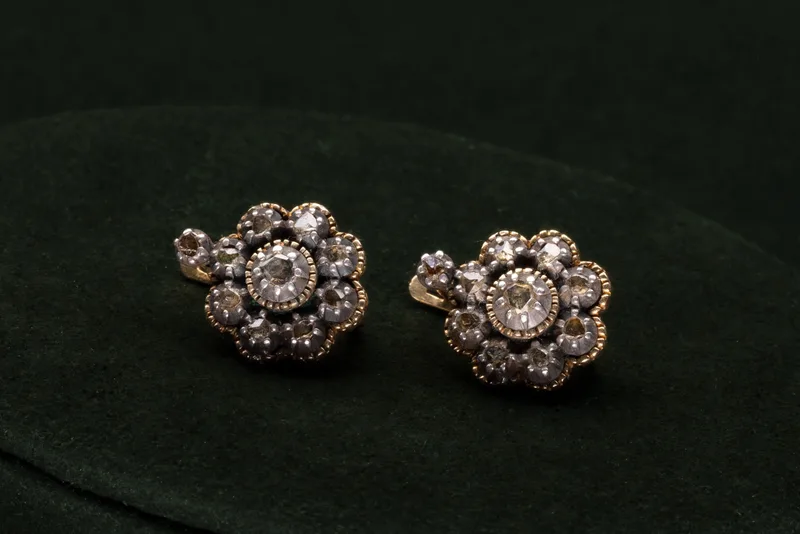
A pair of earrings
Estimate €300–500

850
Estimate €100.000–180.000
Silver topped gold entirely set with 935 old brilliant cut diamonds with a total approximate weight of 96.68 carats.
Comprising six pieces: a hair 'aigrette en tremblant'; a comb/bodice ornament with a large central diamond; a necklace with pendant; a pair of convertible earrings; a brooch; and a ring.
Hair 'aigrette en tremblant' set in open setting with 360 old brilliant cut diamonds with a total approximate weight of 18.95 carats.
Comb/bodice ornament set in open setting with 72 old brilliant cut diamonds with a total approximate weight of 3.20 carats, plus a large old brilliant cut diamond with an approximate weight of 8.70 carats (14.8x12.35x6.30mm), fine color (I~K) and clarity (SI) and strong blue fluorescence.
Necklace with pendant set in open setting with 368 old brilliant cut diamonds with a total approximate weight of 40.15 carats; plus two larger old brilliant cut diamonds one with an approximate weight of 2.43 carats (8.30x7.60x4.65mm), and the other with an approximate weight of 4.15 carats (9.35x9.25x5.8mm), both of fine color (G~I) and clarity (VS) and medium blue fluorescence.
Pair of convertible earrings set in open setting with 76 old brilliant cut diamonds with a total approximate weight of 10.10 carats.
Brooch set in open setting with 39 old brilliant cut diamonds with a total approximate weight of 4.70 carats.
Ring set in closed setting with 16 old brilliant cut diamonds with a total approximate weight of 2.50 carats, plus the central old brilliant cut diamond with an approximate weight of 1.80 carats.
Portugal, 1800-1820.
(signs of wear, earring clasps altered in the early twentieth century for unpierced ears, three very small diamonds missing)
9cm (H. aigrette without pin), 6.2cm (L. comb), 4.8cm (L. earrings), 42 cm (necklace), 2.7 cm (brooch), 16.7mm (ring size)
37.8 g (aigrette), 12.4 g (comb), 13.6 g (earrings), 50 g (necklace), 6.8 g (brooch), 6.2 g (ring)
Historical Diamond Jewellery – The Ultimate Luxury
The discovery of this Neoclassical diamond parure, from the collections of the Counts of Podentes, represents a remarkable contribution to the history of nineteenth-century Portuguese art. This is because, in Portugal, jewellery was one of the artistic activities in which the highest levels of quality and talent were achieved between the eighteenth and nineteenth centuries.
Rooted in a deeply established tradition, Portuguese jewellery underwent remarkable developments following the massive influx, from the mid-eighteenth century onwards, of gemstones from Brazil, in every colour and quality. The abundant availability of precious stones stimulated creativity and technical refinement, as well as increasing production volumes, making jewellery one of Portugal’s most internationally acclaimed artistic pursuits and attracting numerous foreign master craftsmen, particularly to Lisbon.
From 1760 onwards, the Portuguese Crown, through an agreement with the Dutch consul Daniel Gildemeester, brought stability to the diamond trade originating in Brazil, consolidating its position as an indispensable player in the commercial networks of these gemstones, then of exorbitant value. Indeed, until the 1820s, Portuguese diplomacy cultivated, among the other European courts, the image of the kings of Portugal as “the lords of diamonds”.
Encouraged by the availability of raw materials and skilled labour, Portuguese tastes in jewellery acquisition fostered aesthetic and material innovations that gave rise to formal and technical distinctive features, defining the production of the period from the 1760s to the 1830s - a period that, tellingly, remains the most highly regarded and valued by both art historians and the art market.
Jewellery production has always existed at different levels of quality, responding to the demand of clients with varying purchasing power and cultural sensibilities. Consequently, the different segments of jewellery creation cannot be distinguished solely along the lines of erudite and popular production, as traditional historiography has tended to do. In both spheres - popular and erudite - there have always been different levels of quality in design and execution, as well as, naturally, in the value of the materials employed.
It is worth recalling, for instance, that the most celebrated expression of eighteenth- and nineteenth-century Portuguese high jewellery today corresponds to a segment of production that made use of the wealth of relatively inexpensive Brazilian gemstones - topazes, beryls, quartz, chrysoberyls and tourmalines - to create extravagant and highly sophisticated jewels of comparatively moderate value. Produced in the same workshops, according to the same designs and techniques as diamond jewels - which at the time were astronomically expensive - it was precisely their more modest material value that ensured the survival of these pieces in the face of the voracious destruction of Portugal’s high jewellery heritage throughout the nineteenth and twentieth centuries.
To better understand why the richest diamond jewels have almost entirely disappeared, it is essential to place the value of these stones within the economic realities of the early nineteenth century. An examination of jewellery valuations from the transition between the eighteenth and nineteenth centuries reveals that, at the time, a fine brilliant-cut diamond weighing approximately 10 carats - comparable to the largest diamond in the Podentes parure - was worth around 3 contos. This sum was equivalent to 469 gold coins of 6,400 réis (the celebrated 'peças'), or approximately 6.7 kilograms of 916/000 gold - metal whose intrinsic value today stands at around €750,000.
Indeed, the value of large jewels set with brilliant-cut diamonds - the most sophisticated and expensive cut then available - frequently exceeded the price of palaces and country estates. For example, in 1802, Queen Carlota Joaquina acquired the Ramalhão Palace in Sintra, “and adjoining estates”, for 15 contos, whereas her bridal jewels, presented by the Portuguese royal family in 1785 and composed entirely of diamonds, were valued at approximately 90 contos.
Given sums of this magnitude, it is not difficult to understand why large jewels set with substantial diamonds were destined for such short lives. This was particularly true in Portugal, a country devastated both emotionally and financially by successive wars, political upheavals and financial crises throughout the nineteenth century. Today, jewels set with brilliant-cut diamonds that survived from the pre-Civil War period are genuine exceptions. Looted, sold, lost through loans, dismantled or remodelled to suit changing fashions, the overwhelming majority of the great diamond jewels of the Marian period gradually disappeared, leaving traces only in the remarkable inventories and valuations of the pre-revolutionary era.
The Most Opulent Portuguese Neoclassical Jewel in Private Collections?
The emergence of a Neoclassical parure comprising six pieces and set entirely with almost one thousand brilliant-cut diamonds, with a total weight of approximately one hundred carats, is therefore an almost unprecedented rarity.
Indeed, we know of no comparable ensemble surviving in private collections, nor is there any parure of these characteristics in Portuguese public collections. An ensemble featuring fine-quality brilliants, several weighing over one carat, including one of almost nine carats and another of four and a half carats, finds its only parallel in what remains of the former Portuguese royal collections, now housed at the Ajuda National Palace - and even there, no complete parure from this period survives.
In the jewels of the Podentes parure, beyond the material quality of the gemstones and precious metals, the erudition of the designs and the masterful manner in which they were executed are immediately apparent. The hair ornament, shaped as a naturalistic plume and known at the time as an 'aigrette' or 'martinete', is constructed from gold plates that allow its upper elements to oscillate. The perfectly engineered articulations of the necklace and the pair of earrings, meanwhile, enable them to follow the wearer's every movement, allowing the particularly refined designs of their twisted and palmette-shaped forms, as well as their small crescent moons, to catch the light. All are executed with remarkable precision.
With the exception of the ring - which may be two or three decades older than the remaining pieces of the parure - all the jewels are constructed entirely using open-backed settings, with an exceptionally light touch. Their workmanship recalls the finest jewels made for the Portuguese royal family in the early 1800s by Carlos José van Nes, José Luís da Silva and António Gomes da Silva. Indeed, in a portrait of Queen Carlota Joaquina painted by Jean-Baptiste Debret in 1817, on the occasion of the marriage of the heir apparent, Prince Pedro [IV], the Queen wears jewels displaying clear stylistic affinities with those of the Podentes parure. These similarities are evident in both the necklace and earrings, as well as in the plume of the sophisticated hair ornament created for the occasion by António Gomes da Silva.
A Remarkable parure from a Remarkable Family
The singularity of these jewels extends beyond their exceptional material qualities and considerable artistic merit. It is equally rare to encounter pieces with such distinguished provenance. Having remained in the same family for nine generations, the history of the Podentes parure can be traced back to the remarkable Eugénia Cândida da Fonseca (c. 1765-1843), 1st Baroness of Silva [The Grão Vasco National Museum preserves a second portrait of the 1st Baroness of Silva, also by José de Almeida Furtado, dated to around 1826 (inv. 2497)].
Possessed of an immense fortune, the 1st Baroness of Silva was an extraordinary woman whose character extended far beyond the brilliance with which she managed her business affairs. Deeply political, she defended the Liberal cause to the utmost. Imprisoned as soon as Dom Miguel ascended the throne, she remained incarcerated for four years, until her release following Dom Pedro IV's arrival in Porto. As early as 1825, King João VI had granted her a coat of arms; following the Civil War, Queen Maria II elevated her to the rank of Baroness and appointed her a Lady of the Order of Christ, in recognition of her bravery and exceptional character.
The Baroness of Silva was, indeed, a remarkable woman who consistently transcended the limitations that her female status might have imposed upon her. Even in her appearance - by cultivating a provocative moustache, the quintessentially masculine attribute - she defied convention. What had once been the subject of ridicule among the Miguelist faction, who mockingly called her “the bearded woman”, became the proud emblem of an unshakable woman.
During her imprisonment, her son Francisco António Mendes da Fonseca (1792–1832) also fled absolutist persecution, taking refuge in Paris, where he died at the age of 39, just months before his mother was released. Francisco was likewise an immensely wealthy merchant, having participated in two tobacco-contract syndicates until 1823. In 1821, he married Margarida Amália da Costa e Almeida (1802–1871), the orphaned daughter of Francisco Bernardo da Costa e Almeida (1764–1812), Lieutenant-Governor of the fortress of Almeida, who was unjustly executed by firing squad in 1812 on Beresford's orders. She was the sister of António de Pádua da Costa e Almeida (1794–1867), a veteran Liberal known as General Pádua, who was created 1st Count of Tavira in 1861.
In the 1820s, at the height of their brief marriage, Margarida Amália and Francisco Mendes da Fonseca commissioned portraits from the distinguished painter José de Almeida Furtado, known as “o Gata” (1778–1831) [The Caramulo Museum is reported to hold a second portrait of Francisco Mendes da Fonseca in its collection, also by José de Almeida Furtado. Although the identity of the sitter in that painting had remained unknown, it can now be established beyond any doubt].
In her portrait, Margarida, then in her twenties, wears one of the earrings from the parure now coming to auction, meticulously and brilliantly rendered by Almeida Furtado [In the early twentieth century, the fastenings of the earrings were altered to screw-back fittings for unpierced ears. At that time, the rosette-shaped elements that hung from the centre of each earring were removed, precisely because they had originally dangled from the hooks of the original fittings].
Of the three children born to Margarida Amália and Francisco António Mendes da Fonseca, Maria Liberata da Costa Mendes (1823–1906) is of particular interest. She was nine years old when her father died in Paris. Under the protection of her mother and grandmother, the Baroness of Silva, Maria Liberata married Jerónimo de Azevedo e Vasconcelos (1805–1885) in 1837, a veteran Liberal who had also been imprisoned under the absolutist regime. In 1851, Jerónimo received the title of 1st Viscount of Podentes and, in 1865, that of 1st Count of Podentes.
Portrayed by the Viseu-born painter António José Pereira in the 1860s, the Countess of Podentes, then around forty years old, was immortalised on canvas wearing the Neoclassical diamond parure that had belonged to her mother and grandmother. By then, these jewels were already several decades old, and the wearing of such 'aigrettes' in the hair was no longer fashionable.
Undoubtedly the owner of numerous more contemporary jewels - such as the Romantic bracelet worn on her left arm, or the magnificent floral diamond parure worn by her daughter Margarida in a portrait painted around 1855 - the Countess of Podentes nevertheless chose these early nineteenth-century pieces for her portrait of the 1860s, most likely because of their symbolic and commemorative significance.
Ingeniously placed at the apex of the bodice, the 'aigrette' in António José Pereira's painting serves as a counterpoint to the Viscountess's face, framed by the pair of earrings, the necklace and the brooch featuring the large diamond of almost nine carats, worn as a 'devant-corsage'.
The Counts of Podentes had only one daughter, Margarida Amália Mendes de Azevedo e Vasconcelos (1838–1887). In 1853, the year in which they both turned fifteen, Margarida married Carlos Relvas (1838–1894), the extraordinary and multifaceted millionaire from the Ribatejo region who, among his many talents, became the most celebrated Portuguese photographer of the nineteenth century. Between 1871 and 1875, he was responsible for the construction, in Golegã, of a photographic studio building internationally recognised as unique and open to visitors today.
Carlos Relvas's achievements were remarkable in numerous fields, from photography to agricultural modernisation, as well as equestrian pursuits and bullfighting. At the age of fifteen, he was awarded the Order of Our Lady of the Conception of Vila Viçosa, which he displays in the previously unpublished portrait illustrated here, painted around 1855.
He was showered with honours in Portugal, having declined the title of Count of Golegã, and throughout the rest of Europe, where he received, among others, the Orders of Isabella the Catholic (Spain), the Legion of Honour (France) and the Crown of Italy. An eccentric and liberal-minded man, he was a staunch monarchist and a personal friend of Kings Fernando II and Luís.
Among the children of Margarida and Carlos Relvas, José Relvas (1858–1929) was particularly distinguished. A major art collector, he was responsible for the construction of the Casa dos Patudos, today the remarkable museum of Alpiarça. He married Eugénia Couto Leitão (1865–1951), also a great-granddaughter of the 1st Baroness of Silva and therefore his second cousin.
Unlike his father, José Relvas embraced the Republican cause and was the man who proclaimed the establishment of the Portuguese Republic from the balcony of Lisbon's City Hall on 5 October 1910.
The youngest daughter of Margarida and Carlos Relvas, Margarida Augusta Relvas (1876–1930), was also a fascinating figure, becoming celebrated in the history of Portuguese photography as Margarida Relvas. Having learned the art of photography from her father, she practised it with exceptional results. Very recently - between October 2025 and February of this year - her work was included in the exhibition "O que elas viram, o que nós vemos", at the Chiado Museum, dedicated to the pioneering women of photography in Portugal [National Museum of Contemporary Art, on view from 16 October 2025 to 1 February 2026. Curated by Susana Lourenço Marques and Emília Tavares].
Inherited from her mother, the photographer Margarida Relvas became the owner of this extraordinary Neoclassical diamond parure. Having passed through nine generations of the same family, it is now presented by MATER at its inaugural auction, a privilege of which the firm is deeply honoured.
The emergence of a magnificent jewel with more than two hundred years of history, impeccable aristocratic provenance and first-water gemstones - above all, brilliant-cut diamonds - constitutes a memorable and exceptionally rare event in the Portuguese cultural landscape, as well as in the global art market.
João Júlio Rumsey Teixeira
Co-founder of MATER; Head of the Jewellery and Silver Department.
(translated with AI)
Possibly Eugénia Cândida da Fonseca, 1st Baroness da Silva (1765–1843);
her daughter-in-law, Margarida Amália da Costa e Almeida (1802–1871);
her daughter, Maria Liberata da Costa Mendes, Countess of Podentes (1823–1906);
her daughter, Margarida Amália Mendes de Azevedo e Vasconcelos (1838–1887), wife of Carlos Relvas;
her daughter, Margarida Augusta de Azevedo Relvas (1876–1930), celebrated as Margarida Relvas photographer;
by direct descent.
An aigrette in the form of a plume (subsequently adapted as a brooch), of the same period and exceptional quality as the hair pin now offered for sale, is part of the collection of the Museu Nacional de Arte Antiga (1197Joa), originally from the collections of the Counts of Aurora, by descent from the Viscounts of Mesquitela.
A related necklace, although constructed in closed setting and set with smaller diamonds, is part of the IFC collection (CJ19224IFC), likewise provenant from the collections of the Counts of Aurora. See PONTE, António and MEDINA, Susana (2026) - Coleção IFC: Matéria de Sonhos. Porto: MNSR, pp. 166 and 172.
For Portuguese jewellery drawings from the first half of the nineteenth century depicting these type of pieces see SOUSA, Gonçalo de Vasconcelos e (2011) - O Livro de Desenhos de Jóias de José António Mourão (1792-1856), da Rua das Flores, no Porto. Porto: UCE, pp. 9, 11, 21 and 31 of the annex; and SOUSA, Gonçalo de Vasconcelos e (2010) - Percursos da Joalharia em Portugal, séculos XVIII a XX. Porto: UCE, figs. 59 and 66.
The relationship between what we see and what we know is never complete. The way we see things is influenced by what we know, or by what we believe.