920
A Belle-Époque salver – regatta trophy 1903
Estimate €830–1.400

919
Estimate €3.000–5.000
Electrotype.
Electroformed and silver-plated copper.
C. W. Fleischmann, Munich, 1875–1900.
Copy of a Portuguese silver-gilt salver c.1510–1520, preserved in the Kunsthistorisches Museum, Vienna (inv. no. 904).
5x50 cm
2,629 g
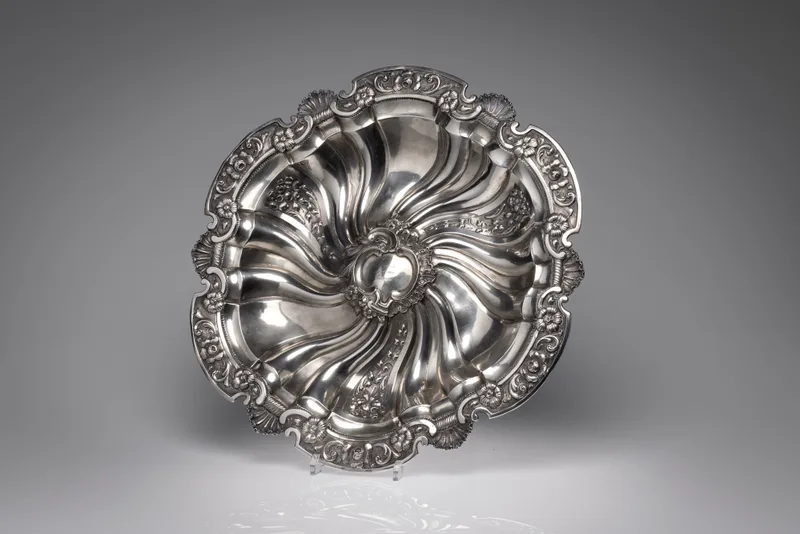
This magnificent basin is a historic copy of an early 16th-century Portuguese basin in the Kunsthistorisches Museum in Vienna. It is characteristic of the highly ornamented Portuguese silver that became so popular among collectors and art educators during the second half of the 19th century. No space is left undecorated, but the lively design is kept controlled in distinct horizontal bands that give the scenes a sense of movement as the basin turns full circle.
The outer rim is divided into eight scenes that depict the biblical story of Judith and Holofernes. The composition is crammed with figures showing the city of Bethulia under siege and culminates at the top with Holofernes passing out drunk followed by a view of the cover of his tent being pulled back as Judith holds his severed head. The inner rim or bouge is divided into twelve scenes of courtly life divided by twisted columns terminating in masks. The inner convex band shows armoured soldiers marching to war between two large castles. In the centre of the basin is the coat of arms of the Lobos da Silveira, Barons of Alvito, with its five wolves in a shield surrounded by a border of diagonal crosses.
Turning the basin over is very revealing. Firstly, the thin, granular surface with encrustations of copper at the outward facing edges shows this basin is an electrotype. It was formed by depositing pure copper from solution into a mould taken from the original basin in Vienna. As the mould was a single open-faced mould, the back of the electrotype bears no relation to the back of the original as it is merely the negative of the deposit from the front.
Comparing the fronts of the original and the electrotype it appears that the first moulds were made by copying each of the circular sections separately. Separate copper deposits would have been created in these moulds to create ‘type patterns’ from which future moulds could be made for creating multiple copies. The type patterns were like photographic negatives to which one could turn for new moulds as the original was too fragile for repeated moulding. On this electrotype, the type patterns have been placed in a slightly different orientation from the original before a mould was made, as on the original, Holofernes’s tent is to the left of the coat of arms rather than above it.
The back also has an old label fixed to it that while difficult to read appears to give an inventory number of 2056 and at the bottom reveals the manufacturer, or at least the retailer, as ‘C.W. Fleischmann, München’. The C.W. Fleischmann company had factories in both Nuremberg and Munich selling primarily ceramic copies of Renaissance and Baroque tankards and flagons, but their catalogues also included accurate copies of medieval bronze aquamaniles and electrotypes of Renaissance silver.
It is unlikely that Fleischmann had direct access to the original silver-gilt basin in the Kunsthistorisches Museum in Vienna. The first electrotypes of it were produced by the Viennese metalworker, Carl Haas in the mid-1860s. Curator André Afonso showed two other electrotypes of the basin at an exhibition in 2021-22, ‘Tão úteis como os originais’ held at the Museu Nacional de Arte Antiga, one by Haas and the other unidentified. Interestingly, they both have Holofernes’s tent at the top of the composition, like the Fleischmann basin now offered for sale at MATER Fine Art. It is quite possible that C.W. Fleischmann acquired a Haas electrotype and made their own moulds from it to retail under their own name.
The process of electrotyping was so accurate that copies could be made from copies with no loss of quality. Until recently, electrotypes were frequently dismissed as mere reproductions but now they are understood to be interesting objects in their own right, of deep historical significance with their own biographies that are quite separate from the originals. Electrotypes were a by-product of the invention of electroplating which revolutionised the trade of coating base metal objects with silver. Patented by Elkington and Company, of Birmingham England in the 1840s, the technique was the fulfilment of a century of research into the effects of electricity on metals and the first commercial application of electricity to the production of luxury household goods. Electrolytic deposition transferred metals from solution to solid state at a molecular level for the first time making the copies far more accurate than casting. Electrotypes represent a combination of 19th-century art and industry that was at the very beginning of the electrical revolution.
Electrotypes are best understood then as three-dimensional images. They capture the state of an object in three dimensions at that moment it was copied. It is no coincidence that electrotyping was invented at around the same time as photography. Subtle differences from original to copy remain, however. The assembly of the type patterns before moulding probably accounts for the slight difference in dimensions from the original basin at 50.7 cm diameter and the copy which is 50.0 cm.
Demonstrations of electrotyping at the Great Exhibition in London in 1851 suggested a new industrial alchemy had been discovered and by 1867, its potential for creating extremely accurate copies of both historic and modern ornamental works of art from around the world was being used by governments, national museums and royal collections across Europe. At the Paris Exposition of 1867, ‘A Convention for Promoting Universally Reproductions of Works of Art for the Benefit of Museums of all Countries’ was organised by Henry Cole, Director of the South Kensington Museum in London (now the V&A) that was signed by 13 European princes including Archdukes Louis Charles and Rainer of Austria. The Convention was a diplomatic agreement to make objects from national and royal collections available for moulding by electrotyping companies who were then to publish catalogues of what they might sell.
An early beneficiary of this convention was the Vienna Exposition of 1873 where Carl Haas showed and advertised for sale a number of reproductions from the collections of the KHM. It is most likely that a copy of the Portuguese basin was among them. This drive to reproduce the works of goldsmiths from 300 years earlier grew out of a contemporary dissatisfaction with the state of modern design and the impact of industrial development on hand craft. It is somewhat ironic that this newest of industrial processes was employed to address this issue. Electrotyping massively boosted the collections of historic works in museums and art colleges around the world and providing a sourcebook of European decorative history to inspire modern designers.
Electrotype like this basin copies enabled historic works of art to be broadcast around the world. In 1877, travel writer Joaquim de Vasconcelas wrote that ‘Nobody has told us before that at Vienna Schatzkammer is kept one of the rarest masterpieces of late 15th-century Portuguese goldsmithery,’ and he later wrote, ‘The salver is a first-class object, both in its technical as well as artistic aspects … this salver illustrates the late 15th century Portuguese goldsmithery in its highest degree of extraordinary virtuosity.’ He may have been slightly mistaken with the date of the original but his excitement captures the huge European enthusiasm for the possibilities offered by these extraordinary copies.
Angus Patterson
Senior Curator at the Victoria and Albert Museum, London.
Further Reading:
André Afonso, ‘Tão Uteis Como Os Originales’: A Coleção de Galvanoplatias do MNAA, Exhibition at the Museo Nacional De Arte Antigua, Sala do Tecto Pintado, 2021-22
Alistair Grant and Angus Patterson, The Museum and the Factory: The V&A, Elkington and the Electrical Revolution, V&A/Lund Humphreys, London, 2018
Acknowledgements:
I am very grateful to my colleague Kirstin Kennedy, curator at the Victoria and Albert Museum, London for suggesting me as author for this entry. I am also grateful to André Afonso, now of the Calouste Gulbenkian Museum, for information on Carl Haas.
The relationship between what we see and what we know is never complete. The way we see things is influenced by what we know, or by what we believe.