67
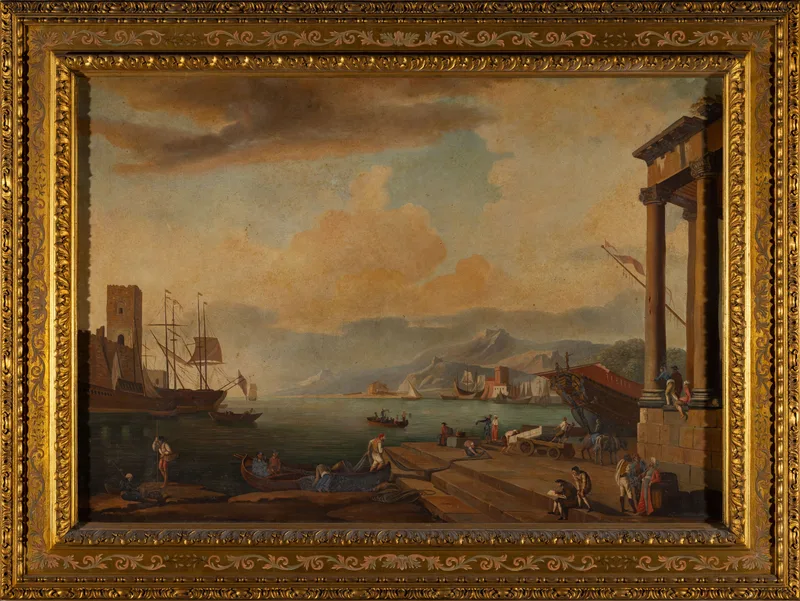
View of a harbour
Estimate €300–500

66
"The Departure"
Estimate €8.000–12.000
Oil on canvas.
Signed.
76x100 cm
ALONSO PÉREZ: father or son
The Departure
The surname Alonso Pérez brings to mind three Spanish painters whose presence in art criticism and art history has, to date, been rather low-key¹: Mariano Alonso Pérez Villagrosa (1857, Zaragoza – 1930, Madrid) and his sons, Carlos Alonso Pérez Berdugo (1882, Rome – 1949, Madrid) and Mariano Alonso Pérez Berdugo (1880 – 1964, Madrid).
Mariano Alonso Pérez Villagrosa undertook his artistic studies at the Royal Academy of the Three Noble Arts of San Luis in Zaragoza, whilst also studying engineering. He later moved to Madrid, where he is listed in the register of copyists at the National Museum of Painting and Sculpture (now the Prado Museum) and where he continued his training at the Special School of Painting, Sculpture and Engraving.
In 1881 he settled in Rome, where he socialised with other Aragonese artists and became friends with the genre painter Ramón Alorda Pérez. It was during this period in Rome that he became familiar with the technique of watercolour, producing works that were exhibited in Madrid, Rome and Munich.
In 1889, taking advantage of the Exposition Universelle, he settled in Paris. In the French capital, he came into contact with the art of the Maîtres Pompiers and with some of their leading exponents, including Ernest Meissonier (1815–1891), whose influence is particularly significant for understanding the work of Alonso Pérez. His connection to the artistic circle of William Bouguereau (1825–1905) is also evidenced by a drawing in which he depicts the master in his studio whilst the latter was working on the famous Birth of Venus of 1879.
A regular participant in the Parisian salon exhibitions, he lived at number 33 Avenue de l’Opéra for three years. The respective catalogues allow us to trace his successive changes of address in the city and, at the same time, the growing importance of his artistic and commercial activity in Paris, accompanied by increasing demand for his work, particularly that depicting gallant scenes and episodes of urban life, whether contemporary or inspired by times gone by. Particularly noteworthy are the paintings evoking ‘Vieux Paris’ from the period between the reign of Louis XV and the First French Empire, featuring figures dressed in 18th-century fashion against urban backdrops of cobbled streets and architecture with a medieval flavour, predating the Industrial Revolution and the urban reforms of Baron Haussmann (1809–1891). These are paintings of elegant and vivid scenes of everyday life, in a revivalist style, drawing on the masters of French Rococo painting.
In Paris, Mariano Alonso Pérez Villagrosa diversified his output, working as an illustrator for renowned periodicals such as the Spanish magazine Blanco y Negro, the French Le Figaro Illustré, and the American Vogue.
One of the lesser-known facets of the Aragonese painter and engineer is that of entrepreneur. He was the inventor and promoter of the circus show ‘Autobólido’, which caused a sensation in capitals such as Paris, Lisbon and New York. First performed at the Folies Bergère theatre in Paris in 1904, this attraction was billed as the first-ever somersault in a motor car, taking place in a richly decorated auditorium lit by electricity. Inside the racing car – which travelled fourteen metres in a parabolic arc before the somersault – there was always a well-known acrobat and circus actress, Mauricia de Thiers (1880–1964). As it was a highly risky spectacle, Mauricia eventually suffered a serious accident in Lisbon in 1906, in the presence of King Carlos (1863–1908).
With the outbreak of the First World War (1914–1918), the painter returned to Spain, settling in Madrid from then on.
His sons, Carlos and Mariano, also pursued artistic careers, although their work remains relatively little studied. Trained and influenced by their father, they developed a style very similar to his, particularly in the early stages of their careers, to such an extent that it is sometimes difficult to distinguish the authorship of certain paintings, given the formal and thematic similarities with their father’s work. This difficulty is compounded by the similarity between some of the signatures used by the three artists. The present painting, signed ‘Alonso-Pérez’, is one such case; based on the evidence currently available, it is not possible to determine whether it was painted by the patriarch or by one of his sons.
The work now being offered for auction by MATER forms part of the genre painting tradition developed by the Alonso Pérez family, which is particularly associated with the international renown achieved by the patriarch between the late nineteenth century and the early twentieth century. In the scene depicted, a young flower seller approaches a group of elegantly dressed men and women as they emerge from a classical-style building, decked out for a festive occasion. The façade’s decoration, featuring red fabric garlands with golden fringes, may suggest the celebration of a civil wedding². In the foreground, the child carrying the flowers witnesses the event, waiting for the right moment to try to sell his wares. The presence of this street vendor introduces a second narrative layer and establishes a counterpoint between the group of adults and the child, engaged in a commercial activity, linking the urban landscape, the human composition and the narrative details depicted. The work is thus a representative example of the Alonso Pérez family’s pictorial output, drawing on the so-called ‘petites histoires’, framed by lavishly carved and gilded Neo-Rococo frames, which reinforce the decorative nature of these paintings. Rather than major historical or mythological themes, these works offered an idealised and picturesque view of everyday life.
Fernando Montesinos
Conservador do Palácio Nacional de Sintra (PSML)
BIBLIOGRAFIA
BÉNÉZIT, Emmanuel (2006): Dictionary of artists, v.10, Paris, Éditions Gründ.
FIGOLS, Paula (dir.): La seducción de París. Artistas aragoneses del siglo XX, Zaragoza, Ibercaja. Catálogo da exposição patente no Museo Camón Aznar, Zaragoza, de 26 de janeiro a 18 de março de 2005.
GARCÍA LORANCA, Ana e GARCÍA-RAMA, J. Ramón (1992): Pintores del siglo XIX. Aragón, La Rioja y Guadalajara, Zaragoza, Zaragoza, Ibercaja.
GONZÁLEZ, Carlos e MARTÍ, Montse (1989): Pintores españoles en París (1850-1900), Barcelona, Tusquets Editores.
JUBERÍAS GRACIA, Guillermo (2020): Entre la bohemia y el salón. París y la pintura de género aragonesa (1870-1914), Zaragoza, Rolde de Estudios Aragoneses.
LOMBA SERRANO, Concha (dir.): Roma y París, horizonte de los artistas aragoneses (1875-1920). Colección Francisco Palá Laguna, Zaragoza, Prensas de la Universidad de Zaragoza. Catálogo da exposição patente no Edificio Paraninfo da Universidad de Zaragoza, de 22 de abril a 18 de julho de 2026.
The relationship between what we see and what we know is never complete. The way we see things is influenced by what we know, or by what we believe.